
Sustainable Packaging Material Solution for Refill Systems
Reference Standard: Relevant material and performance testing standards include ASTM D1693 for polyethylene environmental stress-cracking resistance and ISO 9001:2015 quality management principles for controlled production and inspection.
Short Answer
When the Outer Case Stays in Service Longer Than the Formula Inside
Sustainable packaging material is often described through recycled resin content, biodegradability, or disposal routes, but the refill bottle system in this catalog creates a different procurement question: which part of the package should remain in service after the formula is used up? The answer is not a generic material slogan. It is a structural division between a PP pump, a PE inner bottle, and a PP outer case, with the outer case acting as a reusable frame while the inner bottle is replaced.
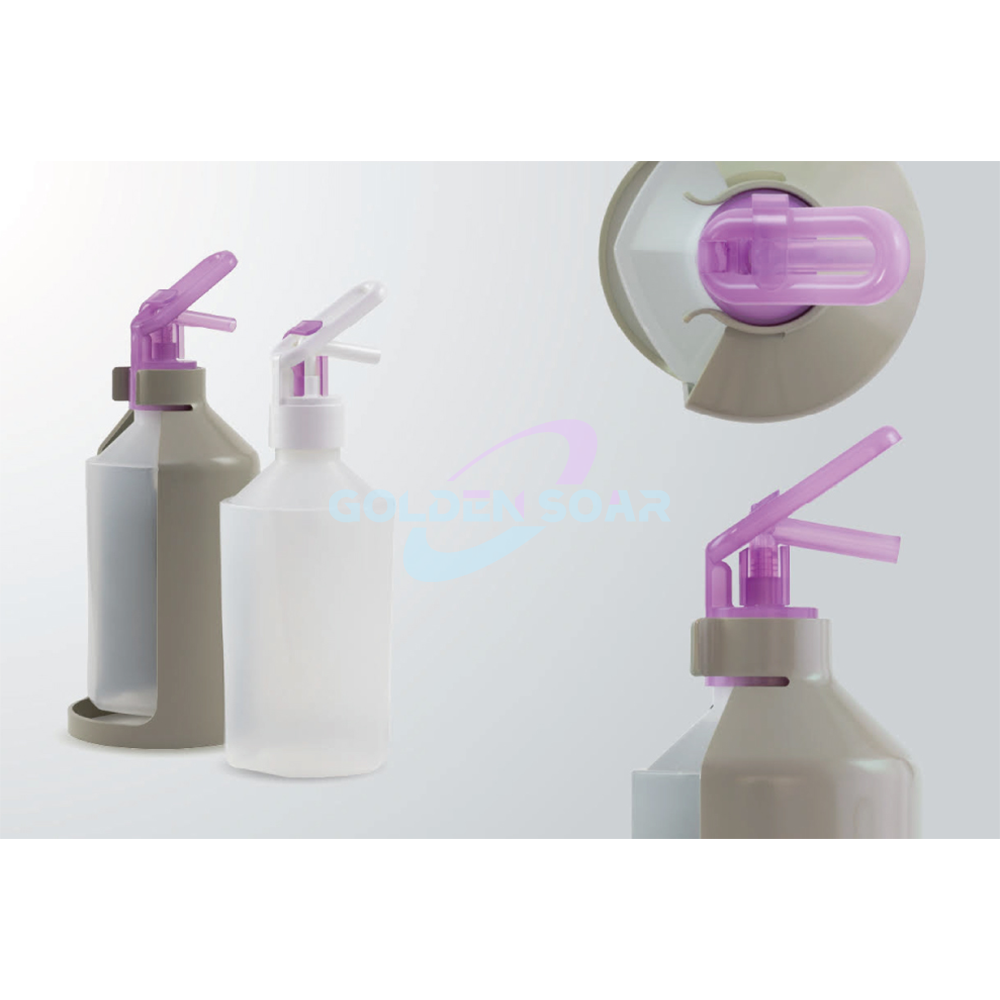
The documented refill airless system uses Product Code P-GS003, with full capacity of 451.9ml y recommended capacity of 420ml. Its component weights are also specific: PP pump 17.3g, PE inner bottle 25.5g, y PP outer case 65g. These numbers change how a buyer should read the packaging. The heaviest component is not the disposable inner bottle; it is the outer case. That makes the outer case a candidate for repeated use, while the lighter inner bottle becomes the controlled replacement element.

The practical value is not simply “less plastic.” It is component service zoning. A one-piece bottle forces the brand to retire the whole object after every consumption cycle. A refill system asks whether the exterior structure, visual identity, and handling frame can stay in circulation while the contact container changes. In procurement terms, this reduces the number of components that must be treated as single-cycle packaging, although the exact reduction ratio would need project-specific mass, refill frequency, and consumer behavior data.
A useful edge-condition model is a repeated replacement environment for a viscous skincare lotion or hair mask. In the first cycle, the outer PP case mostly carries display, grip, and support functions. In the middle cycles, its role shifts toward alignment: it must hold the PE inner bottle firmly enough that the pump, bottle, and case still behave as one package. In a late-cycle scenario, the buyer should inspect whether the outer frame still supports the inner bottle without looseness, visible deformation, or misalignment around the pump interface. The catalog does not provide a lifetime cycle count, so the safe procurement approach is to validate repeated assembly behavior before scaling.
A cross-dimensional comparison helps clarify the difference. A standard refillable bottle without a dedicated outer frame depends heavily on the bottle wall itself for both contact storage and hand feel. A refill airless structure divides those duties: the PE inner bottle holds and collapses with the formula, while the PP outer case maintains overall stability. This matters for skincare refill packaging, hair care refill packaging, y replaceable airless bottle systems where the refill action must remain understandable to the consumer after purchase.
The Shrinking Inner Bottle as a Visible Material Ledger
The refill bottle system also introduces a less common idea: the package records material use through its own physical movement. The catalog describes a reserved opening on the back of the outer shell, allowing the user to see how the inner bottle contracts. The inner bottle is a vacuum-type design, and the bottle can shrink along its intended structure as the contents are dispensed. This visible contraction turns the package into a simple material ledger: the buyer and user can see that the inner bottle is not merely holding product, but actively participating in product evacuation.
The key mechanism is deformation under controlled dispensing. In a rigid bottle, viscous content may remain near shoulders, corners, or bottom zones after normal use. In a collapsible inner bottle, the container geometry changes as the volume decreases. The catalog also refers to pre-designed creases, a spiral structure, and minimal residue for thick formulations. These are not decorative details. They guide where the PE inner bottle should fold, helping the package move in a predictable way rather than collapsing randomly.
An edge-condition model can be built around a high-viscosity conditioner, cream, or serum stored at normal indoor temperature and used repeatedly. At the initial stage, the inner bottle still has most of its volume, so wall deformation is limited and the pump draws from a stable internal reservoir. At the mid-use stage, the inner bottle begins to contract visibly through the reserved opening, and the package should show a controlled shrinking pattern rather than wrinkling unevenly. At the extreme late-use stage, the remaining formula becomes harder to move in any packaging system, but the airless shrinking structure should reduce dead zones compared with a non-collapsing container. This is an engineering inference based on the documented vacuum-type and collapsing inner bottle design, not a claim of zero residue.
The comparison test case is straightforward. Place a non-collapsible pump bottle and a refill airless inner bottle into the same use model with a thick lotion. The rigid bottle relies on dip-tube reach, bottle geometry, and user angle. The refill airless bottle relies on the internal container reducing volume as product leaves. The second system creates a visible state change, which allows the buyer to inspect behavior during sample testing: does the inner bottle contract smoothly, does the reserved opening show remaining quantity clearly, and does the structure avoid uncontrolled buckling?

KEY TAKEAWAYS
- Uneven inner bottle wrinkling may indicate uncontrolled collapse rather than guided contraction.
- Poor visibility through the reserved opening weakens the refill system’s remaining-product signal.
- A loose outer frame can turn the shrinking inner bottle from a controlled ledger into a handling problem.
This section should not be read as a hygiene routine or pump endurance discussion. The important point is that a sustainable packaging structure becomes easier to evaluate when the physical package exposes its own use state. For OEM buyers, that visible state can become part of sample approval: not only whether the package looks acceptable before filling, but whether it behaves logically after the formula starts leaving the container.
Sustainability Claims That Survive Component Separation
A sustainable claim is stronger when it survives disassembly. In this refill system, the buyer should not treat the package as one material object. The pump is PP, the inner bottle is PE, and the outer case is PP. The wider material options in the catalog include PP, PET, HDPE, y eco-friendly bio-resins, while PE packaging may support 30% to 100% post-consumer recycled resin blends. These facts should be used as component-level procurement boundaries, not as a broad promise that every configuration has the same sustainability profile.
The material logic is tied to role assignment. PP is used where stiffness, mechanical shape, and component stability are useful, such as the pump and outer case. PE is used where a collapsible contact bottle can support airless dispensing and formula evacuation. PET, HDPE, and bio-resin options may be relevant to other packaging formats or customized projects, but their suitability must be verified against the actual component role. A buyer should ask: is the material being selected for contact compatibility, structural support, visual effect, refill behavior, or recyclability messaging?
This is where the refill system differs from a simple material comparison. PE has documented engineering relevance in the catalog: HDPE density is 0.93–0.97 g/cm³, LDPE density is 0.91–0.94 g/cm³, and PE can be tested for environmental stress-cracking resistance under ASTM D1693. The catalog notes testing in 10% Igepal solution at 50°C and exposure above 168 hours. PE can also receive flame treatment or corona discharge to raise surface energy above 38 dynes/cm for better decoration adhesion. Those facts matter, but they should not dominate this article’s angle. Here, they function as verification points for component separation.
| Component or variable | Procurement role | Relevant documented data | Validation focus |
|---|---|---|---|
| PP pump | Dispensing and connection | Pump weight: 17.3g | Fit stability, dispensing path, assembly alignment |
| PE inner bottle | Formula contact and collapse | Inner bottle weight: 25.5g | Collapse behavior, residue reduction, formula compatibility |
| PP outer case | Reusable support frame | Outer case weight: 65g | Reuse handling, case support, replacement alignment |
| PE material option | Flexible or rigid packaging basis | HDPE 0.93–0.97 g/cm³, LDPE 0.91–0.94 g/cm³ | Density selection, ESCR behavior, filling suitability |
| PCR resin blend | Recycled-content option | 30%–100% PCR available | Batch approval, component-specific application boundary |
| Surface treatment | Decoration support | Surface energy above 38 dynes/cm | Print adhesion after flame or corona treatment |
A cross-system test case should separate component claims. One sample can be built around the standard refill system with PP pump, PE inner bottle, and PP outer case. A second sample can be requested with a PCR resin blend or alternative eco-friendly material where technically feasible. The buyer should not compare them only by appearance. The better evaluation asks whether the same replacement behavior, assembly alignment, and contact safety assumptions still hold after material changes. A resin change that improves sustainability messaging but disrupts fit, collapse, or decoration approval may create a hidden specification mismatch.
The edge scenario is an OEM line extension where a brand wants custom logo, packaging, and color while also requesting sustainable positioning. Color and surface finish may be important, but the structural claim must stay intact after customization. If a branded surface treatment interferes with assembly tolerance, if a material change alters collapse behavior, or if a replacement cartridge becomes hard to identify, the sustainable packaging system loses clarity. Buyers sourcing PE dual chamber packaging or refill airless systems should evaluate materials by part function rather than by a single package-level label.
Reorder Confidence Built From Replacement Behavior, Not First-Sample Appearance
A first sample can look impressive and still fail as a repeatable refill solution. For this sustainable packaging material category, reorder confidence should be built from replacement behavior: how the consumer attaches the pump, slides the refill bottle into the outer case, locks it in place with one click, dispenses with one hand, and reads the visible remaining-product signal. These actions decide whether the packaging idea survives real use.
The catalog describes easy assembly: attach the pump to the refill bottle, slide it into the outer case, and lock it in place with one click. That sequence turns packaging from a passive container into a small mechanical system. The procurement question becomes less about whether the first assembled unit looks clean, and more about whether the replacement action is simple enough to repeat consistently. If the refill requires excessive alignment knowledge, unclear orientation, or unstable locking feedback, the consumer may treat the system as inconvenient even when the material selection is technically sound.
A practical solution layer should include four approval paths.
Solution 1: Component-fit approval before decoration approval.
Execution protocol: Approve the PP pump, PE inner bottle, and PP outer case as a working set before finalizing decoration. The sample review should include pump attachment, bottle insertion, one-click locking, and removal of the used inner bottle. The review should not stop at still photography or first-sample appearance.
Expected material evolution: The physical materials are not expected to change during review, but the acceptance criteria become more measurable. Buyers can compare inner bottle fit, case support, and pump alignment across samples instead of relying on visual impression.
Hidden cost and side-effect control: This approach may extend sample review because more handling steps are checked. The tradeoff is useful because late tooling or decoration changes can become more expensive than early assembly correction.
Solution 2: Inner-bottle contraction inspection during sample filling.
Execution protocol: Fill the PE inner bottle with a formula-like liquid that represents the target viscosity range, then observe the contraction path through the reserved opening during use. The buyer should record whether the spiral structure and creases guide the collapse as expected.
Expected material evolution: The inner bottle should transition from a filled shape to a contracted shape without uncontrolled buckling. The visible state should remain readable enough to act as a remaining-product indicator.
Hidden cost and side-effect control: Using a formula substitute can reduce test cost, but it may not fully reflect the final formulation. For high-value formulas, a later compatibility check with the actual product remains necessary.
Solution 3: Component-level material boundary control.
Execution protocol: Define which component uses PP, which uses PE, and whether PCR resin blends, HDPE, PET, or bio-resins are being requested for any part. Do not approve a broad sustainability claim without linking it to a specific component.
Expected material evolution: Clear component boundaries reduce confusion when resin choices, color matching, or surface finishes change. A buyer can request targeted tests instead of restarting full-package qualification.
Hidden cost and side-effect control: Component-level control requires more detailed specification documents. The benefit is that it prevents a sustainable material substitution from weakening the mechanical logic of the refill system.
Solution 4: Reorder simulation after repeated replacement.
Execution protocol: Conduct a small internal replacement trial using several assembled units. The test should follow the same sequence a consumer would use: attach, insert, lock, dispense, observe remaining content, remove, and replace.
Expected material evolution: The outer case should maintain support, the pump should remain aligned, and the inner bottle should remain easy to identify and replace. No exact durability cycle count should be invented unless supplied by testing.
Hidden cost and side-effect control: This trial requires sample quantities and time, but it helps the buyer avoid ordering a package that performs well only as a static display unit.
| Approval variable | Acceptable review direction | Common test basis | Risk if ignored |
|---|---|---|---|
| Pump-to-inner-bottle fit | Smooth attachment without forced alignment | Manual assembly trial | Consumer confusion during refill |
| Inner bottle contraction | Visible, guided collapse through the case opening | Filled-use observation | Poor remaining-product signal |
| Outer case support | Stable holding frame after replacement | Repeated insertion and removal | Loose or tilted package structure |
| PE stress resistance | ESCR checked where surfactant formulas are relevant | ASTM D1693 logic | Contact-container cracking risk |
| Decoration surface readiness | Surface energy checked after treatment | Flame or corona treatment review | Weak print or foil bonding |
| Material substitution | Component-specific approval | Resin and part-role review | Sustainability claim weakens function |
PRO-TIP / CHECKLIST
- Confirm whether the sustainable claim applies to the full package or only specific components.
- Review the PP pump, PE inner bottle, and PP outer case as a complete operating set.
- Test replacement behavior before approving color, logo, or retail artwork.
- Observe inner bottle contraction through the reserved opening during sample use.
- Avoid assigning PCR or bio-resin options to a component without checking fit and function.
- Verify leak behavior, assembly stability, and visible remaining-product indication before bulk ordering.
- Keep the refill action simple enough for a non-technical consumer to repeat without instruction.
For buyers comparing custom sustainable packaging, the strongest reorder signal is not the first sample’s visual polish. It is whether the refill system makes repeated purchase logical: the outer case stays useful, the inner bottle changes cleanly, the pump remains intuitive, and the consumer understands what part is being replaced.
Frequently Asked Questions (FAQ)
What materials are used in packaging?
Common packaging materials include PE, PP, PET, glass, metal, paperboard, and bio-based materials. In this refill system, the documented structure uses a PP pump, PE inner bottle, y PP outer case, with additional options such as PET, HDPE, PCR resin blends, and eco-friendly bio-resins depending on component requirements.
What is the most common packaging material used?
Plastic materials such as PE, PP, and PET are widely used because they support different packaging functions. PE is common for squeezable or contact bottles, PP is used for pumps, caps, and structural parts, and PET is often selected when clarity and bottle strength are important.
What packaging materials are biodegradable?
Some bio-based or compostable materials may be biodegradable, but biodegradability depends on the specific resin and disposal environment. The catalog mentions eco-friendly bio-resins as an available material option, but it does not provide a dedicated biodegradation test result, so claims should be verified before marketing use.
What is a material submittal package?
A material submittal package is a document set used to confirm material, component, specification, and testing information before approval. For refill sustainable packaging, it should identify the PP pump, PE inner bottle, PP outer case, capacity, component weights, surface treatment, ESCR relevance, and requested customization details.
How much do businesses spend on packaging materials?
Packaging cost depends on material, mold complexity, capacity, decoration, order quantity, and testing requirements. For refill airless packaging, cost evaluation should separate the reusable outer case, replaceable inner bottle, pump component, decoration method, and any PCR or bio-resin requirement instead of treating the package as one simple bottle.
 English
 Español
 Русский
 日本語
日本語 한국어
한국어 Français
 العربية
 Português