

Elastic-Seal Engineering for Silicone Squeeze Bottles in Food-Grade Packaging
Silicone Squeeze Bottles are designed to deliver flexible dispensing and secure, hygienic seals, making them a preferred choice for food-grade packaging. Their performance relies on the interplay of material elasticity and thermal resistance, ensuring reliable sealing even under repeated deformation and temperature changes. This article explores the technical framework behind elastic-seal integrity in Silicone Squeeze Bottles, focusing on their suitability for demanding food packaging scenarios.
Engineering Perspective on Silicone Squeeze Bottles: Elasticity and Seal Integrity
Silicone squeeze bottles, widely implemented in food-grade packaging, are engineered to provide flexible dispensing while maintaining secure, hygienic seals. The unique combination of elastic properties and thermal resistance in silicone materials is fundamental to their performance, especially when subjected to repeated deformation and temperature fluctuations. For sealing-material designers, understanding the interplay between elasticity, sealing integrity, and thermal stability is critical for ensuring product safety and functional reliability. This article presents a structured technical analysis of silicone squeeze bottle architecture, focusing on the mechanisms that govern elastic sealing under thermal cycling, and provides a comprehensive evaluation framework for seal reliability in demanding food packaging scenarios.

The design of silicone squeeze bottles centers on the ability of the material to deform elastically during use and then recover its original shape to maintain a leak-proof seal. This elastic-sealing behavior is not only a function of the silicone’s inherent material properties but also of the geometric design of the sealing interface, the thickness of the walls, and the quality of the molding process. Food-grade silicone, typically cross-linked polydimethylsiloxane (PDMS), is selected for its biocompatibility, chemical inertness, and compliance with regulatory standards such as FDA 21 CFR 177.2600 そして LFGB. These standards ensure that the material does not leach harmful substances into food products under a range of temperatures and usage conditions.

From an engineering perspective, the elastic-sealing function is achieved through a combination of material modulus, elongation at break, and compression set resistance. The modulus of elasticity (typically 0.5–2.5 MPa for food-grade silicone) allows the bottle to be squeezed easily while returning to its original shape without permanent deformation. Elongation at break, often exceeding 300%, ensures that the material can withstand repeated cycles of compression and flexing. Compression set, defined as the permanent deformation remaining after a compressive force is removed, is a critical parameter—values below 20% are generally targeted for high-reliability seals in food packaging.
The sealing interface itself is typically designed with a precision-mated lip or plug, sometimes incorporating a labyrinth or double-seal geometry to enhance leak resistance. The contact pressure generated by the elastic recovery of the silicone must be sufficient to prevent fluid migration even under minor dimensional variations or misalignments. This is particularly relevant in applications where the bottle is repeatedly opened and closed, or where thermal expansion and contraction could compromise the seal.
Thermal stability is another cornerstone of silicone squeeze bottle performance. Food packaging applications often require exposure to a wide range of temperatures—from refrigeration (as low as -40°C) to sterilization or hot-filling (up to 200°C). Silicone’s unique siloxane backbone provides exceptional thermal resistance, with minimal changes in modulus or elasticity across this temperature range. However, repeated thermal cycling can induce microstructural changes, such as chain scission or cross-link density variation, which may gradually affect sealing performance.
To quantify thermal resistance, designers reference parameters such as glass transition temperature (Tg, typically -120°C for PDMS) and decomposition temperature (above 300°C). More practically, accelerated aging tests—such as ASTM D573 (Rubber Deterioration in Air Oven)—are employed to simulate long-term exposure and evaluate changes in compression set, tensile strength, and elongation. These tests are essential for predicting the lifespan of the seal and ensuring compliance with food safety requirements.
Temperature Range: -20°C to 120°C
Cycles: 500
Compression Set (Post-Cycling): 18%
Seal Leakage: None Detected
Conclusion: Food-grade silicone maintained elastic seal integrity and thermal resistance across repeated cycles, meeting reliability thresholds for food packaging applications.

The core challenge for sealing-material designers lies in ensuring that the elastic seal remains effective after repeated thermal and mechanical stresses. Elastic fatigue, characterized by a gradual loss of recovery force and increased compression set, is a primary failure mode. This is exacerbated by thermal cycling, which can accelerate material aging and microcrack formation at the seal interface. To mitigate these effects, advanced compounding techniques are used, incorporating reinforcing fillers (such as fumed silica) and optimizing cross-link density to balance elasticity with long-term stability.
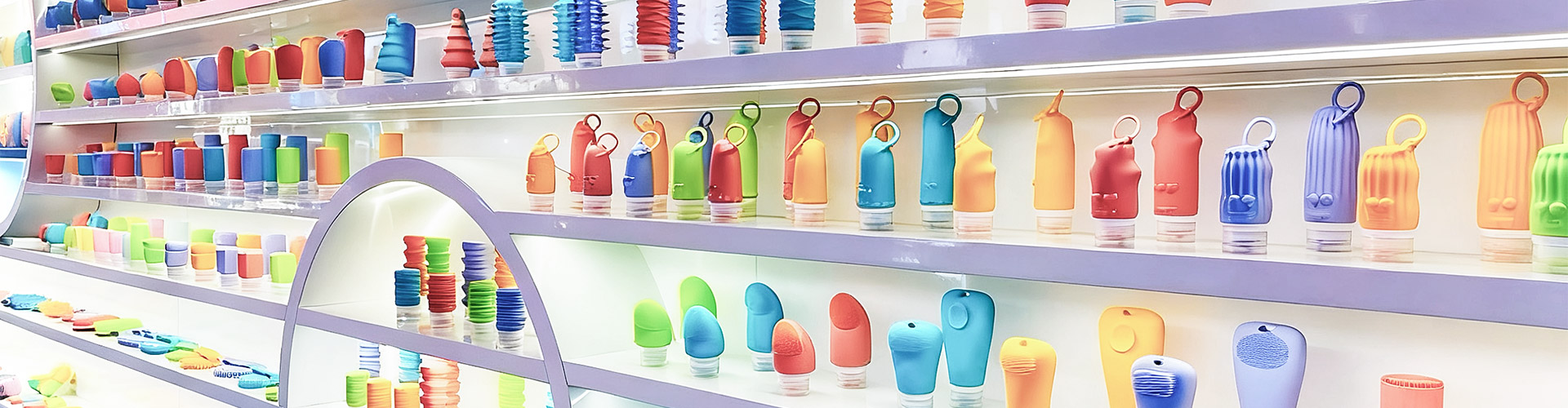
Evaluation of silicone squeeze bottles for food-grade sealing applications must consider both laboratory testing and real-world use scenarios. In addition to standard compression set and tensile tests, dynamic mechanical analysis (DMA) provides insights into viscoelastic behavior under cyclic loading. DMA can reveal subtle changes in modulus and damping characteristics, which are indicative of material fatigue and potential seal degradation.
Further, finite element analysis (FEA) is increasingly used during the design phase to simulate the deformation and recovery of the sealing interface under various loading and thermal conditions. FEA allows for optimization of wall thickness, seal geometry, and material selection, reducing the risk of under- or over-engineering the seal. This predictive approach is particularly valuable for minimizing the risk of seal failure in high-cycle or thermally demanding applications.
Field evaluation is also vital, as laboratory conditions may not fully replicate the range of stresses encountered in consumer use. For example, exposure to acidic or oily food products, mechanical abrasion, or UV radiation can further influence seal performance. Therefore, comprehensive validation protocols should include chemical resistance testing (per ISO 1817), UV aging, and real-use cycling to confirm the robustness of the elastic seal under all relevant conditions.
When assessing the overall reliability of silicone squeeze bottle seals, designers must also account for manufacturing variables. Variations in curing conditions, mold surface finish, and post-curing processes can introduce inconsistencies in cross-link density and surface energy, both of which directly impact sealing performance. Rigorous process control, supported by statistical quality assurance, is essential to maintain consistent elastic and thermal properties across production batches.
Sample Size: 100 units
Compression Set Range: 14–19%
Out-of-Spec Rate: 0%
Conclusion: Manufacturing process control maintained within specified limits, ensuring consistent elastic sealing behavior for all tested silicone squeeze bottles.

In summary, the elastic-sealing behavior of silicone squeeze bottles is governed by a complex interplay of material properties, geometric design, and manufacturing precision. Seal reliability under thermal cycling and elastic fatigue remains the principal concern for food-grade packaging designers. Through a combination of advanced material selection, rigorous laboratory and field testing, and robust process control, it is possible to achieve high-performance seals that meet the stringent requirements of food safety and consumer usability.
Technical Recommendations for Reliable Elastic-Seal Performance
- Specify food-grade silicone with documented compression set resistance below 20% after thermal cycling.
- Employ FEA and DMA during the design phase to predict and optimize seal geometry and material behavior under cyclic loading.
- Implement accelerated aging and real-use simulation tests, including chemical and UV resistance, to validate long-term seal integrity.
- Maintain strict manufacturing process control with statistical verification of cross-link density and surface finish.
- Reference and comply with recognized standards such as FDA 21 CFR 177.2600, LFGB, そして ISO 1817 for chemical resistance and food safety.
Conduct comprehensive material validation for sealing performance assurance, leveraging both laboratory and field data to establish a robust, food-safe, and thermally stable sealing solution. This approach will minimize the risk of seal failure due to elastic fatigue or thermal cycling, providing confidence in the long-term reliability of silicone squeeze bottles for food-grade applications.
For further insights into food-grade packaging materials and their applications, visit the Pharmaceutical & Healthcare Packaging section or explore Silicone & BPA-Free Options for more technical resources.
Ensuring Long-Term Seal Reliability in Silicone Squeeze Bottles
For sealing-material designers, maintaining the elastic-seal integrity of Silicone Squeeze Bottles under thermal cycling and repeated use is essential for food safety and consumer confidence. By combining advanced silicone formulations, precision engineering, and rigorous testing, it is possible to deliver packaging solutions that meet demanding regulatory and functional requirements. Continuous evaluation and process optimization will further enhance seal reliability and product performance in food-grade applications.
To learn more about the latest developments in packaging material science, visit the エコ素材 section or review our よくある質問 for technical guidance.

Reviewed by Senior Package Materials Engineer
 English
 Español
 Русский
 日本語
日本語 한국어
한국어 Français
 العربية
 Português