
Foaming Pump Bottles Testing Guide
Reference Standard: Relevant material and performance testing standards, including ISO 9001 quality management logic and ASTM D1693 environmental stress-cracking resistance methodology for polyethylene-based packaging.
Short Answer
Foaming Pump Bottles sit at a difficult intersection of consumer habit and packaging engineering. The user sees only a small bathroom bottle, but the buyer must evaluate a 350ml capacity, 60g bottle body, PE bottle structure, PP pump head, and 40-thread interface as a combined dispensing system. The product is designed for foaming hand wash, facial cleanser mousse, shower and bath foam products, shampoo, and body lotion applications, so its performance cannot be judged by appearance alone. The real question is whether the package still feels trustworthy after repeated refilling, wet-handed use, and daily pump cycles.
For related packaging comparisons, buyers may also review 250ml PET foaming pump bottles and travel size squeeze bottles for lotion dispensing when mapping refill habits across different personal care formats.
From Refill Habit to Product Trust: Repeated Bathroom Use Changes Foaming Bottle Evaluation
A foaming bottle is judged most harshly after the first refill. During the first use cycle, the pump is new, the bottle surface is clean, and the user often treats the package carefully. After repeated bathroom use, the evaluation becomes more emotional and more mechanical at the same time. The user notices whether the pump still returns smoothly, whether the foam remains fine enough for hand wash or facial cleanser mousse, whether the PE bottle body still looks clean on a wet counter, and whether the PP pump head gives a stable response without feeling loose.
The product data creates a clear baseline: 350ml capacity, 60g weight, 40-thread design, PE bottle, PP pump head, reusable and recyclable material, and applications across foaming hand wash, children’s liquid soap, facial cleanser mousse, shower foam, shampoo, and body lotion. These details matter because refilling changes the package from a one-time container into a small repeated-use appliance. A 350ml bottle is large enough to stay on a bathroom counter for many days, yet light enough at 60g to be handled by adults and children without feeling heavy before filling. That balance makes tactile trust important.
A useful edge-case model is the family bathroom refill cycle. Imagine the bottle used for hand wash in the morning, face cleanser in the evening, and refilled from a larger pouch after several days. The early stage shows stable foam and clean exterior appearance. The middle stage introduces water droplets, soap residue, and repeated actuator contact. The stress stage appears when users mix formulas with different viscosity, refill without rinsing the pump pathway, or leave the bottle in a humid zone. In this model, the buyer should not ask only whether the bottle dispenses foam once. The better question is whether the bottle keeps a consistent trust signal after the refill habit becomes casual.
A cross-dimensional comparison shows the difference between a refillable foaming pump bottle and a basic squeeze bottle. A squeeze bottle depends mostly on body flexibility and cap closure. A foaming bottle depends on the body, thread, pump engine, actuator return, and internal air-liquid mixing path. The PE body provides chemical resistance and squeezable resilience, while the PP pump head supports mechanical movement and foam generation. The 40-thread interface becomes a coordination point between hand torque, sealing contact, and pump stability.
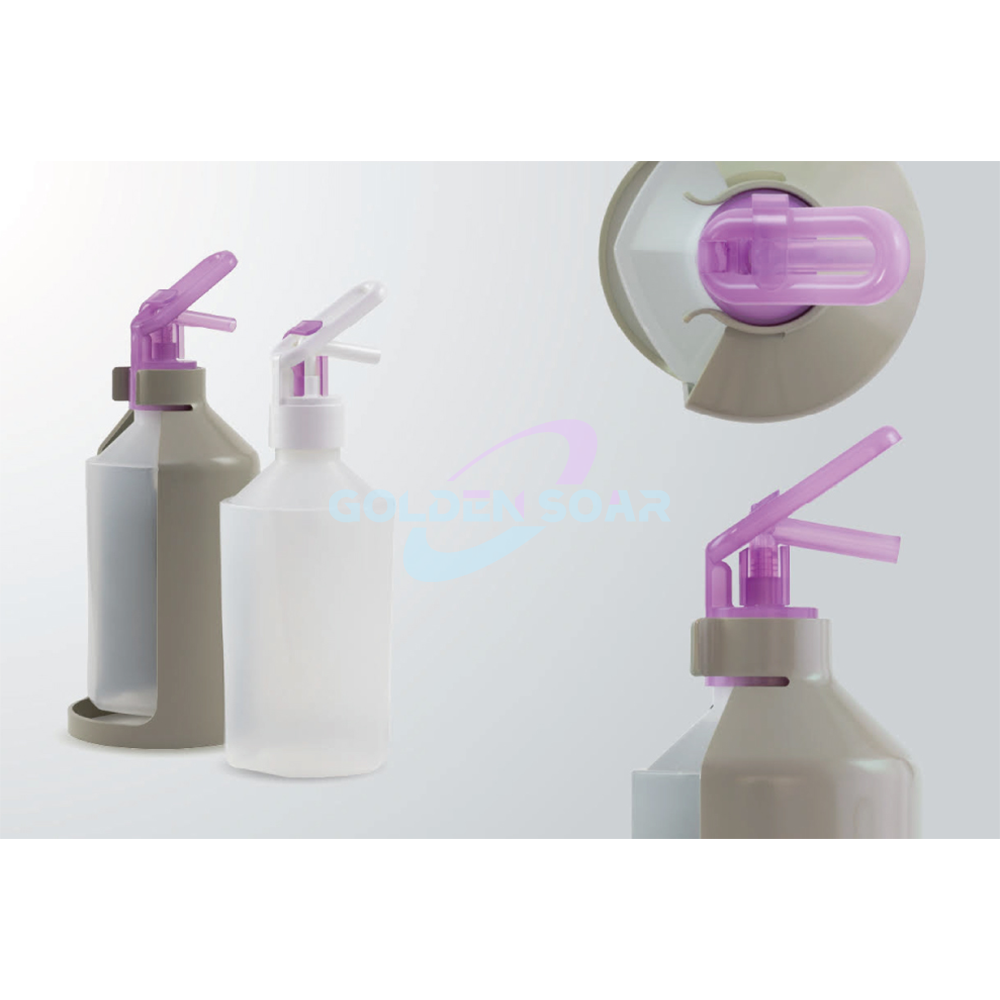
A buyer can use this trust-based framework to avoid shallow inspection. Instead of looking only at color, shape, and logo, the evaluation should follow actual bathroom behavior: wet hands, repeated pressing, children’s use, refill residue, and formula changes. The package should remain easy to identify, easy to handle, and stable in foam output without requiring the user to understand the pump mechanism.
KEY TAKEAWAYS
- A smooth first pump test is not enough; repeated refill use reveals the real trust curve.
- A 350ml PE bottle with a 60g body must balance light handling with stable bathroom presence.
- The 40-thread pump interface should be checked as part of the user experience, not only as a closure detail.
The Decoration Survival Test: PE Foaming Pump Bottles and Wet Brand Signals
Brand visibility on PE foaming packaging is not just a design issue. It is a wet-handling survival problem. The product supports custom color matching, silk print, embossed logo, debossed logo, and OEM/ODM customization for logo, packaging, and color. These features are useful only if the brand signal remains visible after the bottle is handled with damp hands, placed near sink water, wiped with towels, and exposed to cleanser residue.
PE has a practical decoration challenge: it has naturally low surface energy. Without suitable surface preparation, ink may not bond as strongly as buyers expect. The product page confirms silk print, embossed, and debossed logo methods, but it does not specify ink model, tape-test grade, temperature condition, or third-party print durability report. That means the safe procurement logic is to define decoration validation in relation to the actual use environment rather than to assume all decoration methods behave the same.
The edge-case scenario here is a children’s facial cleanser mousse bottle used near a sink. The bottle is pressed with wet hands, moved across a damp counter, and occasionally rubbed where the logo sits. In the early phase, the logo appears sharp and the custom color supports shelf appeal. In the middle phase, repeated water contact and hand oils begin testing the decoration layer. In the stress phase, the brand may lose clarity if printing adhesion was weak, if the surface was not properly prepared, or if the decoration method was not matched to the product’s handling pattern.
A cross-test comparison is useful. Silk printing provides visible graphics and flexible brand expression, but it depends strongly on surface preparation and ink adhesion. Embossing and debossing change the physical surface geometry, so the brand mark is less dependent on ink alone. Custom color matching helps the bottle communicate identity even if the label area becomes wet or partially covered by hand contact. For a refillable bathroom product, the best decoration strategy may combine surface color, structural logo treatment, and carefully validated print placement.
| Decoration Factor | Practical Risk in Wet Use | Data Anchor | Validation Logic |
|---|---|---|---|
| Silk print | Ink wear or weak adhesion | Logo methods include silk print | Check wet rubbing and handling durability |
| Embossed logo | Mold detail may look subtle | Embossed option available | Confirm visibility under bathroom lighting |
| Debossed logo | Residue may settle into recessed areas | Debossed option available | Inspect cleanability after repeated use |
| Custom color | Color drift affects brand consistency | Custom color matching available | Compare batch samples before approval |
| PE surface | Low surface energy can reduce bonding | PE bottle body | Require surface preparation before printing |
This section should not be written as a generic customization service list. A procurement team should treat decoration as part of lifecycle performance. A foaming bottle may sit in the most visible part of a bathroom, hotel amenity area, salon wash zone, or family sink. If the pump still works but the logo becomes unclear, the consumer may still perceive the product as lower quality. In refillable packaging, brand identity must survive handling, not just photography.
PRO-TIP / CHECKLIST
- Request decoration samples using the exact PE color planned for production.
- Compare silk print, embossed, and debossed logo visibility under wet-hand conditions.
- Check whether the logo area is placed where fingers repeatedly touch the bottle.
- Avoid approving decoration only from dry studio photos.
- Include wet rubbing, towel wiping, and cleanser residue checks in sample review.
- Confirm that custom color matching remains consistent across batch samples.
Lightweight Does Not Mean Disposable: 60g Body Logic for Refillable Foaming Packaging
A 60g foaming bottle body can easily be misunderstood. Some buyers may see lightweight packaging as disposable or fragile. That is not the right evaluation method. For this product, the 60g bottle weight must be interpreted together with 350ml capacity, PE bottle body, PP pump head, reusable and recyclable material, MOQ of 10,000 units, and 15-25 days lead time. The point is not to make the bottle feel heavy. The point is to deliver a refillable package that feels stable enough for everyday use while still supporting efficient bulk production and practical handling.
In packaging engineering, weight is not a quality signal by itself. A heavier bottle can still fail if the pump fit is poor, the neck geometry is inconsistent, or the decoration does not survive wet use. A lighter bottle can perform well if the wall distribution, thread formation, pump compatibility, and inspection protocol are controlled. With a PE body, the bottle can offer useful resilience for daily handling. With a PP pump head, the mechanical dispensing component can support repeated actuation. The 40-thread design gives a defined interface for pump-to-bottle assembly.
An edge extreme scenario is bulk bathroom deployment in a hotel, gym, school wash area, or family product line. Bottles are opened, filled, pressed, wiped, moved, and sometimes dropped from low counter height. In the early period, the light body improves handling and reduces perceived clutter. In the middle period, repeated use reveals whether the body keeps its shape and whether the pump alignment remains stable. In the limit period, poor manufacturing consistency may show up as uneven standing, cap wobble, visible scuffing, or inconsistent foam feel. The 60g body therefore needs process discipline, not marketing exaggeration.
The cross-dimensional comparison is between lightweight refillable PE packaging and premium heavy-wall packaging. Heavy-wall packaging can communicate luxury, but it may increase material usage and shipping load. Lightweight refillable packaging communicates daily practicality, but it depends more on molding consistency and pump integration. For foaming hand wash and cleanser routines, a 350ml refillable bottle must feel approachable, safe, and easy to use. The user should not feel that the bottle is disposable after one fill cycle.
From a manufacturing acceptance view, lightweight design should be supported by incoming PE and PP verification, visual inspection for molding defects, thread fit inspection, pump actuation tests, leakage or inversion checks, drop or handling durability checks, and decoration inspection. The reference to ISO 9001:2015 on the product page supports a quality-management approach, while ASTM D1693 provides a known framework for evaluating environmental stress cracking in PE materials. Buyers can review the general purpose of ISO 9001 through the International Organization for Standardization and the role of ASTM standards through ASTM International.
The hidden cost of ignoring lightweight logic is overcorrection. Some buyers may demand more material without defining performance targets. That can increase cost without solving pump fit, decoration durability, or formula compatibility. A better approach is to define what the 60g bottle must prove: standing stability, refill usability, visual cleanliness, pump retention, and acceptable handling after repeated wet use.
Formula Category Boundaries: Judging Soap, Mousse, Cleanser, Shampoo, and Lotion Claims
A foaming pump bottle should not be approved only because it can dispense one sample formula. The product’s stated application range includes shower gel, shampoo, and body lotion, while the usage description also covers hand soap, facial cleanser, mousse, children’s liquid soap, shower and bath foaming products, and travel-size cosmetic foam packaging. These categories do not behave identically. Viscosity, surfactant system, fragrance load, preservative system, and refill habits can change foam output, pump feel, and perceived cleanliness.
The key mechanism is the relationship between formula flow and pump architecture. A PP pump head must move liquid and air through an internal pathway that supports foam formation. A thin hand soap may foam easily but may also leak more readily if the closure system is not stable. A creamy facial cleanser mousse may feel premium but can leave residue in the pump pathway. A shampoo or body lotion formula may be too viscous for stable foaming unless diluted or designed for foam dispensing. The PE bottle body can resist many common personal care formulations, but surfactants can still become stress-cracking agents when molded-in stress and chemical exposure combine.
A practical edge-case model is mixed-formula refilling. A consumer finishes foaming hand wash, rinses the bottle lightly, then refills it with facial cleanser. Later, the same style of bottle is used by another line for shower foam. In the early phase, all products may appear acceptable during a short pump test. In the middle phase, different residue patterns begin affecting foam consistency and pump return feel. In the stress phase, formula mismatch may create poor foam, delayed pump return, or visible residue around the actuator. This does not prove that the bottle is defective; it proves that a multi-claim foaming package needs target-formula validation.
A cross-test case should compare at least four usage categories: hand soap, facial cleanser mousse, shower gel, and body lotion. The test should not invent unsupported formula ratios or pump mesh specifications. It should observe practical outcomes: foam texture, actuator return, pump priming, bottle cleanliness, leakage after inversion, and appearance after wet handling. ASTM D1693 logic is relevant when surfactant exposure and PE stress-cracking risk must be considered, but the buyer should still test the actual formula family.
| Formula Category | Expected Challenge | Product Data Link | Suggested Buyer Check |
|---|---|---|---|
| Foaming hand wash | Refill frequency and wet handling | 350ml PE bottle, PP pump | Foam consistency after repeated use |
| Facial cleanser mousse | Residue and premium hand-feel | High-foaming pump function | Pump return and surface cleanliness |
| Shower gel | Viscosity variation | Applicable to shower gel | Dispensing smoothness and foam quality |
| Shampoo | Surfactant exposure | Applicable to shampoo | ESCR-oriented compatibility review |
| Body lotion | Higher viscosity risk | Applicable to body lotion | Pump suitability before mass approval |
Four solution paths can turn this into a controlled procurement system.
Solution 1: Target-formula pump validation. Execution protocol: test the exact formula type planned for filling, not a generic water-based sample. The sample should be evaluated for priming, foam texture, pump return, residue, and repeated actuation. Material expectation: the PE body and PP pump head remain within their intended functional roles, with reduced risk of formula mismatch. Hidden cost control: testing multiple formulas adds sampling time, but it prevents larger batch disputes after filling.
Solution 2: 40-thread fit and assembly inspection. Execution protocol: inspect the bottle neck and pump fit as a matched system, including thread engagement, cap seating, and hand-tightened assembly feel. Material expectation: the pump-to-bottle interface should maintain stable contact during normal bathroom handling. Hidden cost control: excessive tightening should not be used as a substitute for proper fit, because it may distort user experience or assembly efficiency.
Solution 3: Decoration approval under wet handling. Execution protocol: validate silk print, embossed, or debossed branding after water contact, hand rubbing, and towel wiping. Material expectation: the PE surface and chosen decoration method should preserve legibility and brand identity. Hidden cost control: premium decoration may require more sample rounds, but unclear branding can reduce perceived product quality.
Solution 4: Batch-level refillability review. Execution protocol: combine visual inspection, pump actuation, leakage checks, drop or handling checks, and formula compatibility observations across sample units before approving mass production. Material expectation: the 60g PE bottle and PP pump head perform as a repeat-use package rather than a one-time container. Hidden cost control: inspection should focus on measurable use behavior, not unnecessary overengineering.
KEY TAKEAWAYS
- A broad application list must be converted into target-formula validation before purchase.
- Soap, cleanser, mousse, shampoo, and lotion can create different foam and residue behavior.
- ASTM D1693 logic is relevant for PE stress-cracking risk, but it cannot replace real formula checks.
Frequently Asked Questions (FAQ)
Is foam packaging material recyclable?
Foam packaging can refer to many materials, but these Foaming Pump Bottles use a PE bottle body and PP pump head. PE and PP are commonly recyclable plastic families, yet local recycling acceptance depends on sorting systems, contamination level, and whether mixed components are separated.
What is packaging material?
Packaging material is the physical substance used to contain, protect, dispense, and present a product. In this case, the main packaging materials are PE for the bottle body and PP for the pump head, chosen for refillable personal care and foaming dispensing use.
Is packaging part of raw materials?
In manufacturing accounting, packaging may be treated as a direct material when it becomes part of the finished saleable product. For Foaming Pump Bottles, the PE body, PP pump, decoration, and closure interface are all part of the final packaging specification.
How are biodegradable materials changing the packaging industry?
Biodegradable materials push brands to rethink disposal impact, but they must still meet performance needs such as chemical resistance, pump fit, shelf stability, and decoration durability. For foaming pump packaging, sustainability claims should not replace formula compatibility and refill-use testing.
When reusing hazardous materials packaging, what matters most?
Packaging used for hazardous materials should not be casually reused unless it is specifically rated, cleaned, and validated for that purpose. A personal care foaming pump bottle is intended for compatible soap, cleanser, mousse, shampoo, or lotion applications, not hazardous reuse without proper approval.
 English
 Español
 Русский
 日本語
日本語 한국어
한국어 Français
 العربية
 Português