
Shampoo Conditioner Bottles: Polymer Viscoelasticity and Stress Analysis
Reference Standard: ASTM D1693 Standard Test Method for Environmental Stress-Cracking of Ethylene Plastics and ISO 16103 Packaging – Transport Packaging for Dangerous Goods – Recycled Plastics Material.
Short Answer
Polyolefin Blend Viscoelastic Creep under Sustained Interlocking Top-Load Forces
Polyolefin resins like High-Density Polyethylene and Polypropylene used in shampoo conditioner bottles exhibit distinct viscoelastic properties. When these containers are filled, packed into corrugate shippers, and arranged in multi-layer palletized configurations within warehouses, they face continuous vertical compression forces. Unlike completely elastic materials that deform instantly and maintain a stable shape under static loads, semi-crystalline polymers undergo a slow deformation over time known as viscoelastic creep. Within the polymer matrix, the amorphous or non-crystalline regions consist of loosely tangled molecular chains that act as the primary drivers of this material movement. Under constant top-load stress, these polymer chains slowly disentangle, slide past one another, and align along the load vector, causing a gradual reduction in total bottle height.
Integrating Post-Consumer Recycled resin into the raw material formulation directly alters this creep behavior. Reclaimed polyolefin matrices often possess lower average molecular weights and wider molecular weight distributions due to previous thermal cycles and oxidation during consumer use. These structural changes lower the overall creep modulus and reduce the polymer’s inherent resistance to continuous static forces. As the percentage of post-consumer recycled plastic increases from 30% up to 100%, the volume of shorter polymer chains inside the matrix rises, which lowers the structural yield threshold. Consequently, if stacking loads exceed the structural limits of the recycled blend, the bottle base and midsection undergo permanent deformation, risking stack collapse inside warehouse spaces.
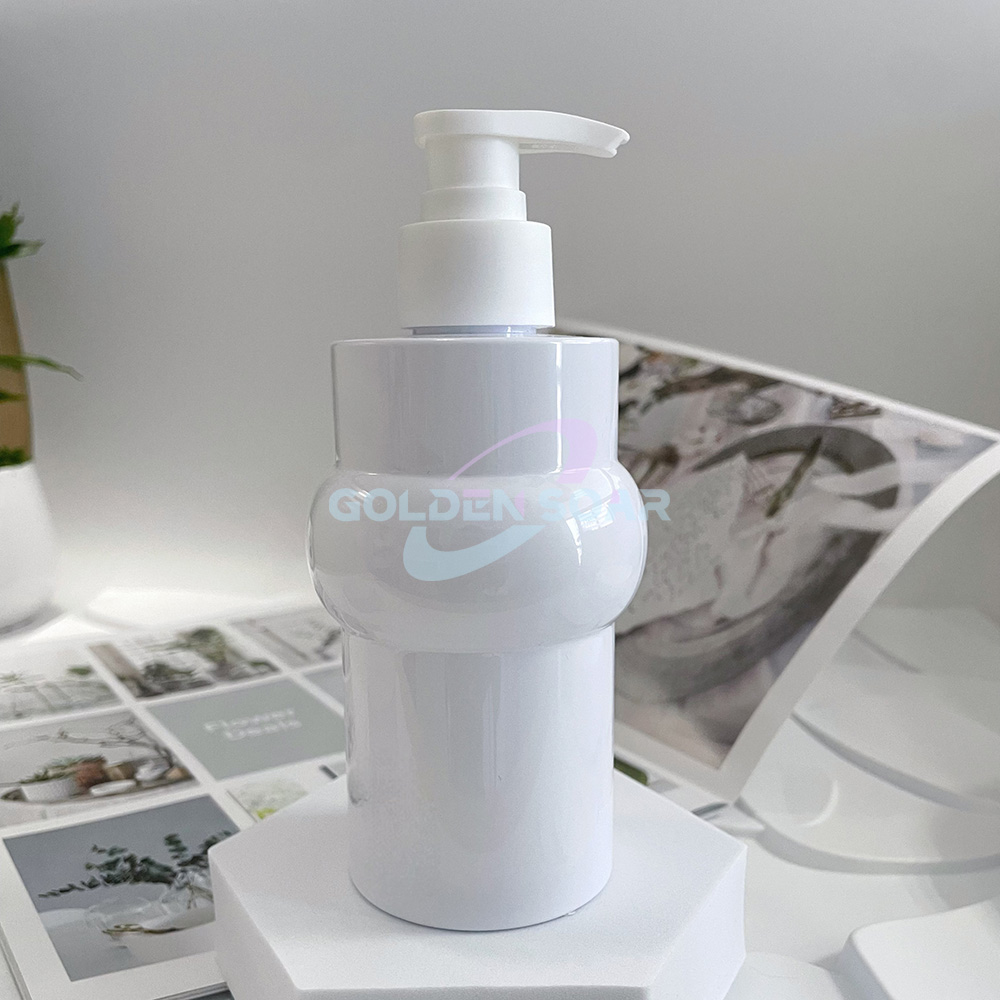
To balance these material performance trade-offs, engineering teams use analytical models to track structural deflection over time. By combining standard finite element methods with the mechanical properties of blended resins, production facilities can predict the exact point where structural failure occurs under heavy stacking conditions.
Static Palletized Compression Model
- Initial Phase (0 to 72 Hours): The container undergoes minor elastic deformation when the initial vertical load is applied. The polyolefin matrix absorbs the compressive forces across its crystalline domains, showing a predictable sub-millimeter reduction in wall height that remains well within safe design tolerances.
- Mid-Term Phase (3 to 30 Days): Viscoelastic creep begins to manifest within the amorphous regions of the polymer. The molecular chains slowly stretch along the vertical stress vector, leading to measurable wall bulging around the lower third of the container profile, especially in high-recycled-content formulations.
- Terminal Phase (Beyond 30 Days): The polymer exceeds its elastic memory limit and enters a stage of permanent plastic deformation. The structural sidewalls buckle outward, causing a severe drop in vertical load-bearing capacity. This deformation creates uneven force distribution across the shipping pallet, which can lead to localized failure and split seams along the container base.
The impact of this long-term viscoelastic creep extends well beyond visible structural damage. As the lower third of the container wall deforms, it generates significant internal hydraulic pressure within the fluid chamber. This pressure transfers directly to the threaded neck joint and the pump dispenser interface. If the neck area has undergone sub-millimeter distortion from top-load forces, this continuous internal pressure can bypass the closure seal, causing product leakage that ruins outer labels and compromises retail presentation.
KEY TAKEAWAYS
- Minor horizontal scuffing or slight outward bowing along the lower third of the bottle wall points to active material creep.
- Vertical alignment gaps between packed boxes on a shipping pallet suggest a drop in individual bottle rigidity.
- Persistent product seepage around the lower threads of pump closures indicates internal pressure shifts caused by body deformation.
Surfactant-Induced Environmental Stress Crazing Resistance (ESCR) Validation Profiles
Shampoo and conditioner formulations contain highly concentrated surfactant matrices, including anionic sodium lauryl sulfate and amphoteric cocamidopropyl betaine. While these chemical compounds are excellent for cleansing, they act as aggressive chemical agents when they come into contact with polyolefin packaging. When these surfactants touch the container’s exterior—either from minor filling line overflow or consumer usage—they migrate into the microscopic surface imperfections of the plastic wall.
The underlying mechanism of environmental stress cracking does not involve direct chemical reaction or polymer chain scission. Instead, the surfactant molecules act as physical wetting agents that lower the surface cohesive energy within the amorphous regions of the polyolefin matrix. When a blow-molded bottle contains internal molded-in stresses from rapid cooling, or faces external mechanical loads, these localized stress concentrations pull on the polymer network. The surfactant molecules slip into the spaces between entangled tie-molecules, accelerating their separation. This process leads to microscopic micro-voids known as crazes. Under continuous stress, these micro-crazes expand and merge into macro-fissures, eventually causing structural splits along high-stress areas like the base parting line.
 English
 Español
 Русский
 日本語
日本語 한국어
한국어 Français
 العربية
 Português