
Package Material Pressure-Chain Perspective
Reference Standard: ASTM D1693 environmental stress-cracking resistance testing for polyethylene packaging, supported by relevant material and performance validation logic from ASTM International and packaging material identification guidance from The Association of Plastic Recyclers.
Short Answer
A package material can look acceptable in a sample room but still behave differently once it moves through molding release, decoration, automated handling, divider packing, filling, and carton distribution. PE, PET, and PP do not fail for the same reason. PE needs stress-crack control and surface-energy treatment, PET needs heat and scratch discipline, and PP needs precision molding control when caps, pumps, hot-fill jars, or chemical-resistant parts are involved.
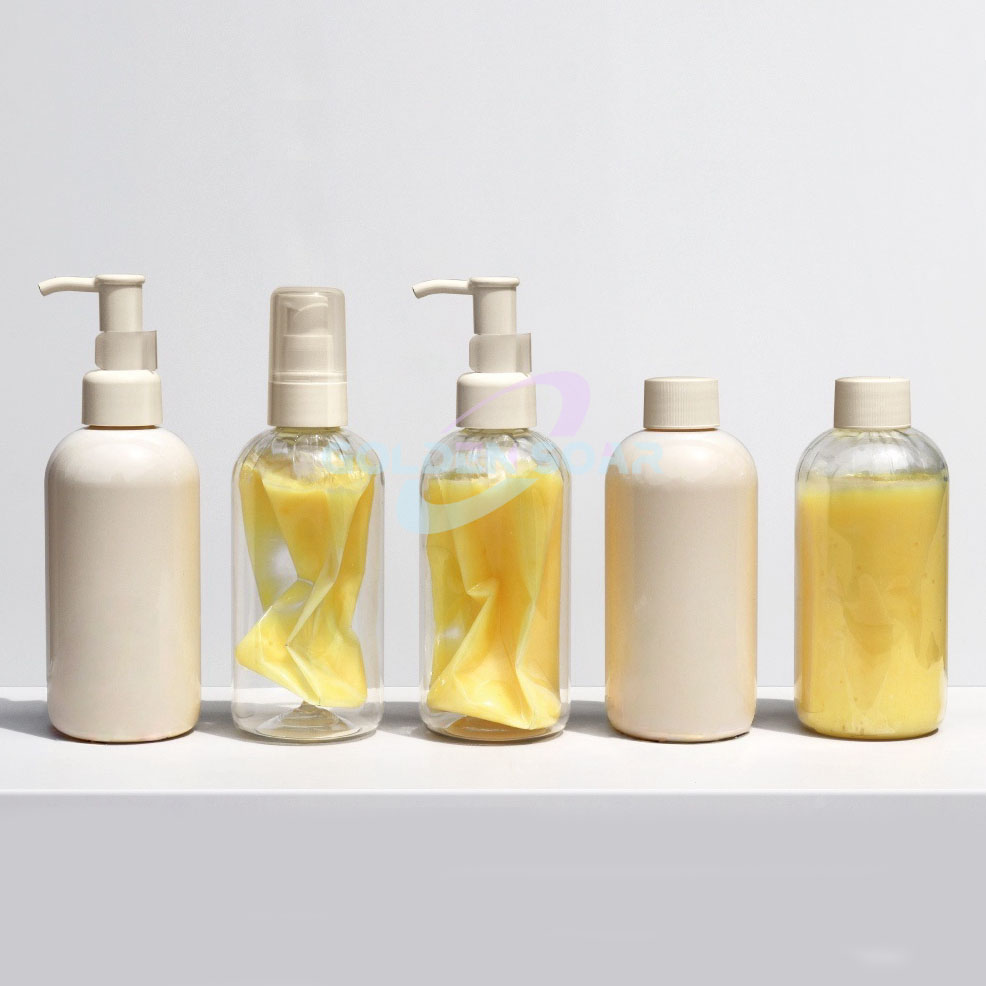
When Package Material Leaves the Mold: First-Shape Stability Before Any Brand Claim
The first technical question is not whether a package looks premium. The first question is whether the molded shape has entered a stable state before printing, pump assembly, cap seating, or carton packing begins. That is where PE, PET, and PP separate into different engineering roles.
PE packaging begins with density behavior. HDPE is listed at 0.93-0.97 g/cm3, 一方 LDPE is listed at 0.91-0.94 g/cm3. This density difference is not a decorative label. It reflects different molecular packing behavior. HDPE’s more linear structure supports greater rigidity, which makes it more suitable for larger shampoo or laundry detergent containers where stacking and sidewall stability matter. LDPE’s branched structure creates flexibility, which is why it is more appropriate for squeeze bottles, travel lotion containers, and refillable personal care formats. Once the bottle leaves the mold, that density decision already defines how much the wall can flex, recover, or resist deformation before a label or pump is added.
PET enters the same moment with a different boundary. It is valued for 92% light transmission, glass-like clarity, and ISBM single-stage molding that supports seamless bottoms, higher drop-impact resistance, and precision neck finishes. Yet standard PET has a real thermal limit: it deforms above 60°C. That means PET can be visually convincing in a sample photograph but still be the wrong choice if the downstream filling process involves high temperature. The first-shape stability of PET is therefore strongly linked to the absence of excessive heat exposure after molding.
PP has another first-shape logic. It is listed with injection-molded tolerance as tight as +/-0.05 mm, melting point of 160°C-170°C, and heat resistance up to 120°C. These values matter when the package material is not just a bottle body but a threaded cap, pump component, closure, airless outer case, or precision jar. PP’s role is not only to resist heat. It must preserve small mechanical features such as threads, snap-fits, pump seats, and hinge geometry after cooling.
Edge extreme scenario model: imagine three molded samples placed into a pre-assembly buffer area before decoration. A PE squeeze bottle is repeatedly compressed during manual sorting, a PET clear bottle waits near a warm filling zone, and a PP closure set is checked for threaded alignment. In the initial stage, all three may look acceptable. In the mid-stage, the PE bottle reveals whether its wall recovery is appropriate for its density grade, the PET body reveals whether heat exposure is close to its deformation boundary, and the PP part reveals whether small tolerances remain stable enough for cap or pump seating. In the limit stage, the visible failure may appear as distortion, leakage, thread mismatch, or surface rejection, but the origin began at first-shape stability.
A cross-dimensional comparison test should pair visual inspection with geometry and process context. For PE, compare a flexible LDPE travel bottle against a more rigid HDPE cleaning bottle under repeated squeeze and side-load conditions. For PET, compare a clear bottle stored below and near the 60°C boundary. For PP, compare a molded closure or pump component against its intended mating part rather than judging it alone. This prevents a common error: approving the material as an isolated object when the real risk appears only after it joins the next operation.
KEY TAKEAWAYS
- A bottle that looks correct after molding may still fail when its material density does not match the next handling step.
- PET clarity does not remove the need to control heat exposure above 60°C.
- PP precision parts should be checked against mating threads, pumps, or closures, not only by visual appearance.
The Hidden Contact Route: Package Material Touchpoints Before Retail
A package material does not travel through production in empty space. It touches conveyors, robotic arms, dividers, polybags, operators’ hands, carton walls, display surfaces, and sometimes other package components. This contact route creates a second layer of risk that is not the same as use damage or post-use marks. It is a pre-retail pressure path.
PET heavy-wall packaging makes this especially visible. Premium PET items may require individual polybagging or layer packing with dividers to reduce scratching. Robotic pick-and-place systems can also minimize surface contact during production. This matters because PET’s selling value often depends on optical quality. A bottle with 92% light transmission can lose perceived quality if micro-scratches, rub marks, or divider abrasion appear before it reaches the filling line or shelf.
PE creates a different contact-route issue. PE is non-polar, so ink and foil do not naturally bond well without surface oxidation. The documented factory fix is flame treatment or corona discharge, raising PE surface energy to above 38 dynes/cm so silk-screen ink and hot-stamping foil can bond more permanently. Contact-route thinking changes the question from “Can this bottle be printed?” to “Will the decorated surface keep its identity after handling, separation, packing, and display contact?”
PP contact behavior is often located in the mechanical zone. Because PP is used for caps, pumps, closures, jars, living hinges, and injection-molded features, contact may happen at small load-bearing points. A PP closure may appear clean, but if the contact route includes vibration, repeated carton compression, or tight nesting before assembly, the eventual issue may be cap seating pressure, pump fit inconsistency, or thread feel. The documented +/-0.05 mm tolerance value should not be treated as a brochure number; it should guide inspection around contact-sensitive geometry.
| Contact route variable | PE packaging concern | PET packaging concern | PP packaging concern |
|---|---|---|---|
| Automated handling | Sidewall pressure and surface rubbing | Scratch risk on clear surfaces | Small-feature deformation at edges |
| Divider or layer packing | Decoration scuff after printing | Optical abrasion on heavy-wall items | Closure edge pressure |
| Pre-filling storage | Wall recovery and decoration adhesion | Heat exposure near 60°C | Dimensional stability of threads |
| Retail display contact | Label and foil durability | Clarity perception | Cap and pump alignment |
| Manual sampling | Squeeze response and surface feel | Fingerprint and scratch visibility | Snap-fit and hinge response |
Cross-dimensional comparison case: use the same contact route on a decorated PE bottle, a clear PET bottle, and a PP closure set. The PE unit should be checked for ink adhesion after rubbing and carton separation. The PET unit should be checked for visible surface haze or scratches under light. The PP part should be checked for thread seating, pump fit, or hinge whitening after contact pressure. The test does not declare one material superior; it reveals which contact route belongs to which material.
The hidden cost appears when surface and structure are judged separately. A decorated PE bottle with untreated surface energy may fail brand presentation. A PET bottle with divider abrasion may look second-grade even if it does not leak. A PP cap with subtle geometry drift may not reveal its problem until it is assembled onto the bottle. For purchasing teams, the contact route should be written into the package material specification before artwork approval or bulk carton planning.
Formula Boundary Is Not the Article’s Main Plot: Use Chemistry Only as a Stress Translator
Formula chemistry matters, but it should not dominate the article as a list of scary ingredients. In package material selection, chemistry works better as a stress translator. It explains how a material will behave when formula pressure meets molded stress, heat, surface treatment, wall thickness, or closure geometry.
PE has the clearest stress-translation example. The documented ESCR logic uses ASTM D1693, with notched samples exposed to 10% Igepal solution at 50°C, and the stated claim is more than 168 hours of exposure. This does not mean every PE package can hold every formula forever. It means surfactant stress should be treated as a measurable acceleration condition. If a shampoo, hand wash, laundry detergent, or cleaning liquid contains surfactant-like stress agents, the PE bottle body should be validated against stress-cracking risk rather than judged only by wall thickness or softness.
PET translates chemistry through heat and clarity. PET is well suited to clear cosmetic packaging, but the documented condition that standard PET deforms above 60°C changes how filling lines should be evaluated. If a brand intends to use warm filling, heated storage, or a formula that remains hot during transfer, PET must be reviewed with caution unless a specialized heat-set PET route is confirmed. PET can offer clarity, drop-impact resistance, and precision necks, but those advantages do not cancel its standard thermal boundary.
PP translates chemistry through heat and chemical inertness. PP is listed as resistant to acids, alkalis, alcohols, oils, and solvents, suitable for hot filling at 85°C-95°C, and stable under higher thermal conditions because its melting point is 160°C-170°C. This makes PP suitable for closures, jars, pump parts, hot waxes, balms, and certain aggressive formulas where PET might haze, deform, or lose dimensional confidence.
Edge extreme scenario model: a package material evaluation team receives three formulas without final decoration approval. One is a surfactant-rich cleansing liquid, one requires warm filling, and one contains oils and alcohol. In the initial stage, the PE bottle, PET bottle, and PP component all pass visual review. In the mid-stage, the surfactant-rich formula pushes PE toward ESCR validation, the warm-fill condition forces PET into temperature review, and the oil or alcohol content pushes PP compatibility into the decision. In the limit stage, cracking, deformation, haze, leakage, or poor pump fit may appear as separate failures, but the true diagnostic value is that each formula has translated into a different material stress.
A practical package material test should avoid one-size-fits-all approval. The same cosmetic bottle family may need PE for squeeze behavior, PET for clarity, and PP for the pump or closure. The risk is not only choosing the wrong resin. It is choosing the right resin for one part of the package while ignoring the chemistry translated through another part.
PRO-TIP / CHECKLIST
- Match PE bottle validation with ESCR risk when surfactants are present.
- Keep standard PET away from filling or storage conditions above 60°C unless heat-set PET is confirmed.
- Use PP for hot-fill or aggressive formula environments where heat and chemical resistance are central.
- Check PE decoration only after surface energy treatment reaches the required bonding range.
- Validate neck, cap, and pump fit as an assembled system, not as separate components.
- Use divider packing or polybagging when PET optical quality is part of the selling value.
- Record whether the sample was tested before or after decoration, assembly, and packing contact.
From Sample Shelf to Bulk Carton: A Nonlinear Checklist for Package Material Decisions
A professional package material decision does not move in a straight line from sample approval to purchase order. It loops between sample shelf, pilot filling, decoration review, carton packing, logistics contact, and retail display. This is why bulk decisions must be written as a nonlinear checklist rather than a simple material preference.
Start with certification and lead-time reality. The catalog states ISO 9001:2015, ASTM-D1693 Standard, 15-25 days lead time, そして MOQ 10,000 units for listed PE material product pages. These are not enough by themselves, but they frame the purchasing rhythm. A buyer approving a PE, PET, or PP package material must decide which tests need to be completed before the MOQ becomes commercial risk.
Solution 1: Define the molded-state acceptance window before decoration.
Execution Protocol: Measure bottle body, neck, thread, pump seat, cap fit, and visible surface condition immediately after molding and cooling. For PE, record whether the selected grade behaves closer to HDPE rigidity or LDPE squeezability. For PET, inspect clarity and dimensional stability before exposing samples to warm environments. For PP, check precision features against mating components.
Expected material evolution: This creates a baseline. PE wall recovery can be judged before printing hides surface changes. PET clarity can be separated from later scratches. PP’s +/-0.05 mm precision target can be linked to assembly performance rather than isolated part appearance.
Hidden cost and side-effect control: Too narrow an acceptance window can reject usable packages; too broad a window allows assembly problems into bulk. The control method is to pair dimensional limits with function checks, not rely on caliper readings alone.
Solution 2: Treat decoration as a surface-energy and contact-route event.
Execution Protocol: For PE, confirm flame or corona treatment and the target of above 38 dynes/cm before silk print, hot stamping, embossing, or debossing is treated as production-ready. After decoration, run controlled rubbing, divider contact, carton separation, and handling simulations.
Expected material evolution: PE’s non-polar surface becomes more receptive to ink or foil bonding after oxidation treatment. The measurable shift is not a visual shine change; it is the increase in surface energy that supports permanent decoration adhesion.
Hidden cost and side-effect control: Over-focusing on print beauty without handling tests can create packaging that photographs well but scuffs in cartons. The safer route is to test decoration after the contact route, not only after printing.
Solution 3: Assign formula stress to the correct material boundary.
Execution Protocol: Use ESCR logic for surfactant-heavy PE applications, temperature review for PET applications, and heat or chemical compatibility review for PP applications. PET should not be approved for standard hot-fill conditions if the process approaches the known deformation boundary above 60°C.
Expected material evolution: PE becomes a stress-crack question, PET becomes a clarity and heat-shape question, and PP becomes a high-temperature precision and chemical-inertness question. This prevents broad phrases such as “chemical resistant plastic” from replacing real selection logic.
Hidden cost and side-effect control: Testing every material against every formula can slow launches. A better method is to group formula pressure by likely stress type, then test the material most exposed to that pressure.
Solution 4: Convert sample approval into bulk carton logic.
Execution Protocol: Before issuing a bulk order, simulate the move from sample shelf to carton packing and retail handling. Check PE sidewall response, PET scratch protection, and PP closure or pump alignment after packing pressure. Tie the test sequence to the MOQ and lead time so approvals occur before 10,000-unit production exposure.
Expected material evolution: Bulk handling reveals small problems that single samples do not show. PET may need divider packing, PE may need decoration adhesion review, and PP may need assembled fit confirmation after carton pressure.
Hidden cost and side-effect control: Carton testing can be underestimated because it looks less technical than resin testing. In practice, it connects material behavior to commercial loss. The control is to define carton handling as a package material validation step, not only a logistics step.
| Decision stage | Required data point | Primary material risk | Validation benchmark |
|---|---|---|---|
| Molded sample shelf | HDPE 0.93-0.97 g/cm3 or LDPE 0.91-0.94 g/cm3 | Wrong rigidity or squeeze recovery | Dimensional and functional inspection |
| Decoration approval | PE surface energy above 38 dynes/cm | Ink or foil adhesion loss | Surface treatment and rub testing |
| Filling simulation | PET deformation above 60°C | Heat distortion | Temperature exposure review |
| Closure and pump fit | PP tolerance down to +/-0.05 mm | Thread or pump mismatch | Assembly fit and torque review |
| Bulk order release | MOQ 10,000 units and 15-25 days lead time | Scaling sample errors into inventory | Pre-bulk validation checklist |
A nonlinear checklist does not slow sourcing when used correctly. It prevents late-stage reversal. A buyer can still choose PE, PET, or PP for familiar reasons, but the approval should show which pressure layer has been tested: molded shape, contact route, formula boundary, and bulk carton movement.
Frequently Asked Questions (FAQ)
Is packaging material taxable?
Packaging material taxability depends on jurisdiction, product use, resale status, and whether the material is treated as part of the finished goods. For industrial sourcing, buyers should confirm local tax rules with a qualified tax advisor rather than using material type alone as the decision basis.
Which organelle packages materials for secretion from the cell?
In cell biology, the Golgi apparatus modifies, sorts, and packages materials for secretion. This query is unrelated to commercial PE, PET, or PP package material, but it appears in search data because the phrase “packages materials” has a separate educational meaning.
Is sealed packaging material recyclable in Rowan County, NC?
Local recycling rules vary by county, resin code, contamination level, and whether the sealed package can be emptied or separated. PET is commonly associated with recycling code #1 and PP with code #5, but Rowan County acceptance should be checked through local waste management guidance.
Where to find packaging materials?
Packaging materials can be sourced from specialized packaging manufacturers, distributors, catalog suppliers, and OEM packaging factories. For PE, PET, or PP packaging, ask for material specifications, MOQ, lead time, test standards, decoration options, and validation data before comparing price alone.
 English
 Español
 Русский
 日本語
日本語 한국어
한국어 Français
 العربية
 Português