
Replaceable Airless Bottle Complete Handbook
Reference Standard: Relevant material and performance testing standards, including PET material behavior validation, airless dispensing checks, leakage inspection, drop-resistance screening, and oxygen-transmission assessment under recognized methods such as ASTM D3985 and transport-package drop testing principles from ASTM D5276. Source-verified catalog data: :contentReference[oaicite:0]{index=0}
Short Answer
A replaceable airless bottle should not be judged only as a beautiful transparent container. For procurement teams, the more important question is whether the bottle can protect the formula from first filling through the final dose, remain stable under normal-temperature handling, avoid unnecessary surface damage during distribution, and fit a realistic custom PET packaging order plan.
The catalog does not provide a separate capacity, weight, wall thickness, pump material, or bottle dimension for this exact replaceable airless bottle. That absence matters. It means the safest specification strategy is to anchor the article in verified PET material facts, the airless vacuum positioning, the refill bottle concept, ISBM processing, and the packaging validation logic that applies to PET cosmetic containers.
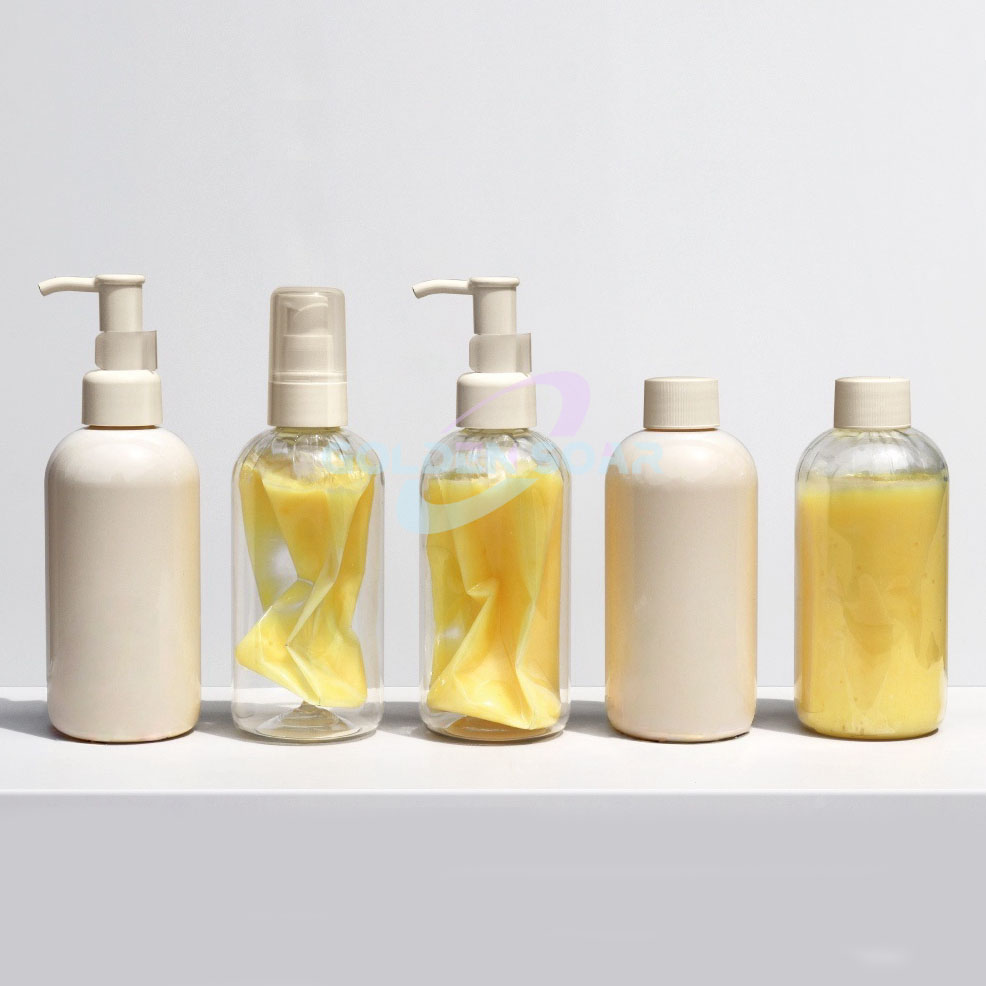
Replaceable Airless Bottle Under the First Fill to Final Dose Stability Curve
The technical value of a replaceable airless bottle becomes visible only when the product is viewed as a time-based stability system. At the first fill, the formula enters a container that must support clean appearance, controlled dispensing, and reduced air exposure. At the middle-use stage, repeated actuation begins to test the dispensing structure, bottle geometry, and formula evacuation behavior. Near the final dose, the system is judged by a different standard: how much usable product remains, whether dispensing still feels consistent, and whether the consumer sees the package as reliable rather than wasteful.
The verified product is listed under PET Materials as a Replaceable Airless Bottle | PET Refill Bottle Innovative Vacuum Container OEM Customizable Packaging Solution. The broader PET material page states that Golden Soar uses single-stage ISBM technology, and that PET packaging can reach 92% light transmission, carries Recycling Code #1, and contains 0% BPA / Phthalates. These are not decorative details. They shape the expected role of the bottle. PET supports clear visual presentation, while the airless and vacuum positioning supports formulas that benefit from reduced contact with outside air during use.
From a material-behavior standpoint, PET is a thermoplastic polyester with strong clarity and good dimensional potential when processed correctly. In single-stage ISBM, the polymer is formed through injection and stretch blow molding logic, orienting the structure in ways that can improve strength and bottle consistency. For an airless bottle, that consistency matters because small variations in the bottle body, neck area, or pump interface can influence leakage risk, pumping resistance, and formula evacuation. The catalog also emphasizes PET precision necks for leak-proof seals with pumps and sprayers, which supports the idea that dispensing stability depends on dimensional control rather than appearance alone.
A useful edge-case model is a normal-temperature bathroom and travel cycle. In the initial phase, the bottle is filled, capped, packed, and shipped. Visual clarity and seal integrity are the first concerns. In the middle phase, the user repeatedly activates the pump while the bottle is exposed to humidity, handling oils, temperature variation within ordinary indoor ranges, and occasional bag movement. At this stage, the system must keep dispensing without air backflow becoming noticeable. In the final phase, the formula level drops and the package is judged by residue behavior. A weak vacuum system may leave more product trapped, while a better-matched airless structure can support cleaner use-down. This model does not require invented capacity or pump composition; it follows the verified airless PET refill positioning.
A cross-dimensional comparison helps: a standard transparent cosmetic bottle can display the formula well but may rely more heavily on user opening, pouring, or dipping behavior. A replaceable airless PET refill bottle is different because the packaging experience is built around dispensing over time. The buyer should compare not only bottle clarity, but also repeated pump behavior, formula evacuation, leakage screening, and refill compatibility. If the product is meant for lotion, serum, cream, or personal care formulas, the procurement test should not end at first visual approval. It should extend across multiple simulated use cycles.
Replaceable Airless Bottle as a Temperature-Limit Procurement Filter
Not every premium transparent package is suitable for every filling process. This is where the replaceable airless bottle must be filtered through temperature logic before design approval. The catalog states that standard PET generally deforms above 60°C and recommends PP bottles or specialized Heat-Set PET molds for hot-fill products. That statement creates a clear procurement boundary: a PET refill airless bottle can be appropriate for normal-temperature cosmetic, skincare, and personal care applications, but it should not be casually specified for high-temperature filling or sterilization without separate validation.
The root cause is material behavior. PET is a thermoplastic material, and its shape stability depends on thermal exposure, wall design, processing history, and cooling behavior. When PET is heated beyond its practical service boundary, dimensional change may appear before complete failure. For a vacuum container, dimensional change is especially important because the airless performance depends on mechanical relationships between bottle body, dispensing pathway, neck finish, pump fit, and internal pressure behavior. Even a subtle deformation at the sealing or support area can change how the package dispenses, vents, or leaks.
An extreme pressure timeline can be modeled without inventing product-specific numbers. In the early stage, a PET airless bottle exposed to a warm warehouse or vehicle cabin may show no visible damage if the temperature remains within ordinary logistics expectations. In the middle stage, repeated exposure to elevated but non-melting heat may create slight dimensional relaxation, especially around thin or stressed regions. In the limit stage, when a standard PET package is pushed beyond the catalog’s 60°C warning zone, deformation can compromise aesthetics, pump alignment, and airless performance. The real risk is not only whether the bottle collapses visibly; it is whether the dispensing system loses consistency before the defect becomes obvious.

A procurement team should therefore build a temperature gate into the request for quotation. The first question is not, “Can the bottle look premium?” It is, “Will the filling, storage, transport, and consumer-use temperature remain compatible with standard PET?” If the brand uses heated bulk formulas that cool after filling, the supplier should confirm whether the fill temperature touches the PET risk zone. If the formula requires hot filling, pasteurization, steam exposure, or any elevated thermal process, the correct conversation shifts toward PP or heat-set PET rather than standard PET.
The cross-system hazard is specification mismatch. A buyer may approve the bottle based on transparency, weight impression, refill concept, and airless appearance, while the factory’s filling line operates at a temperature that belongs to a different material category. The result can be delayed deformation, pump fit drift, leakage complaints, or unexpected rejection during pilot filling. A strong specification sheet should include maximum filling temperature, cooling time, line speed, storage temperature, and test sample inspection after thermal exposure. This turns PET selection into a controlled engineering decision rather than a visual preference.
KEY TAKEAWAYS
- Early thermal risk appears as subtle shape drift, not always immediate collapse.
- A pump that fits during cold inspection may behave differently after heat exposure.
- PET clarity should never be used as evidence of hot-fill suitability.
Replaceable Airless Bottle Surface Protection Beyond Luxury Appearance
Surface protection for a PET replaceable airless bottle is not only about luxury perception. It is a control problem across multiple contact points after production. The catalog notes that premium heavy-wall PET items may use individual polybagging or layer packing with dividers, and that robotic pick-and-place systems minimize surface contact during production. These details shift the conversation from “scratches look bad” to “contact events must be managed before the bottle reaches the brand, filler, retailer, or consumer.”
PET’s high clarity makes surface condition easy to observe. A minor abrasion that would be hidden on an opaque PE or PP package may become visible on transparent PET. In a cosmetic setting, this changes the inspection standard. The same physical mark may be harmless structurally but unacceptable commercially because it affects the perceived cleanliness and premium positioning of the product. Since this replaceable airless bottle is linked to PET Materials and refill cosmetic packaging, surface protection should be considered part of the packaging system, not a secondary shipping detail.
A realistic contact-chain model begins at machine exit. In the initial phase, bottles are formed, released, transferred, and accumulated. If contact is uncontrolled, early micro-abrasion may occur before any human inspection. In the middle phase, bottles move through packing, carton filling, warehouse stacking, and sample distribution. Repeated rubbing between transparent surfaces can create hazing, scuffing, or localized polish changes. In the limit phase, e-commerce distribution or cross-border handling can multiply small contact events. The bottle may pass leakage tests and still fail a brand’s visual acceptance standard because the surface tells a story of poor handling.
The cross-dimensional test case compares three packaging routes. Route A uses loose bulk contact, which may reduce packing labor but raises the risk of surface inconsistency. Route B uses layer packing with dividers, separating bottles and reducing side-to-side movement. Route C uses individual polybagging for premium items, giving each bottle its own contact barrier. None of these routes changes the PET resin itself, but each changes the probability of visible damage. This is why surface protection belongs in the purchasing specification.
| Control Variable | Expected PET Package Behavior | Practical Acceptance Focus | Test Basis |
|---|---|---|---|
| Robotic pick-and-place | Lower uncontrolled handling contact | Fewer early handling marks | Visual inspection and line audit |
| Individual polybagging | Reduced direct surface friction | Better premium appearance retention | Batch sampling after unpacking |
| Layer dividers | Less bottle-to-bottle rubbing | Lower transit scuff risk | Simulated carton vibration review |
| Normal-temperature storage | Better dimensional stability | No heat-related distortion | Temperature log and sample check |
| Pump fit validation | More stable dispensing expectation | No leakage or misalignment | Functional dispensing test |
The hidden cost is packing complexity. More protection can increase material use, packing time, and carton planning requirements. Yet for a transparent PET airless package, poor protection can create a higher downstream cost through rejected samples, retailer complaints, or inconsistent brand presentation. The most practical standard is to match protection level to the selling channel. A domestic bulk refill program, a luxury skincare launch, and an e-commerce sample kit should not share the same packaging protection plan.
Replaceable Airless Bottle MOQ Logic for Custom PET Packaging Decisions
The business logic of a replaceable airless bottle is not limited to choosing a container. It includes material selection, tooling feasibility, color planning, pump compatibility, surface protection, filling process, and minimum order economics. The catalog identifies standard MOQ 10K for PET materials and states that custom colored PET is typically 10,000 pieces because of machine purging. This means a custom PET airless refill bottle should be planned as a production decision, not a casual design request.
A buyer who wants a branded PET refill airless package should separate three decisions. The first is the functional decision: whether an airless vacuum container is needed for the formula and user experience. The second is the material decision: whether PET’s clarity, Recycling Code #1 profile, and BPA / Phthalates statement match the brand and formula context. The third is the customization decision: whether the expected order volume supports color matching, decoration, packaging protection, and repeated production consistency.

Solution 1: Define the normal-temperature formula gate before visual approval.
Execution Protocol: The brand should confirm formula filling temperature, cooling profile, storage condition, and distribution route before selecting a PET airless package. Samples should be checked after exposure to realistic handling and storage conditions. If the formula or filling process moves toward hot-fill territory, the PET choice must be re-evaluated.
Expected Material Evolution: When PET stays inside a compatible temperature window, shape stability, clarity, and pump fit are more likely to remain consistent. If the bottle is exposed near or beyond the standard PET thermal limit, deformation risk increases and may appear as fit drift or visual distortion.
Hidden Cost and Prevention: The main hidden cost is late-stage rejection after decoration or filling trials. It can be reduced by adding a temperature statement to the purchase brief and asking for material-specific filling guidance before artwork approval.
Solution 2: Validate the dispensing system across staged use.
Execution Protocol: Instead of approving only first-pump performance, buyers should test early, mid-cycle, and near-empty dispensing behavior. The test should include leakage inspection, pump rebound, formula evacuation, and user handling under normal conditions. This is especially useful for lotions, serums, creams, and personal care formulas.
Expected Material Evolution: The PET body should maintain shape and visual quality while the dispensing system maintains functional consistency. Airless behavior should reduce unnecessary formula exposure, but each formula still needs compatibility confirmation.
Hidden Cost and Prevention: A bottle may pass appearance review but fail during repeated dispensing. Prevent this by running functional trials before placing a custom color or large decorated order.
Solution 3: Specify surface-contact protection for the shipment route.
Execution Protocol: The buyer should choose individual polybagging, layer packing with dividers, or another protective route based on retail channel, sample-kit needs, and expected transport stress. Inspection should occur after unpacking, not only before packing.
Expected Material Evolution: Protected PET surfaces should show fewer visible scuffs and less contact haze. The bottle’s structural performance may remain unchanged, but its commercial acceptance improves because clarity is preserved.
Hidden Cost and Prevention: Protective packing adds complexity. The trade-off should be judged against the cost of visual rejection, especially for premium skincare and cosmetic launches.
Solution 4: Align customization with MOQ reality.
Execution Protocol: Before requesting custom colors, decoration, or special brand presentation, buyers should confirm whether their demand matches the 10K order logic for PET and custom colored PET. A pre-production review should include color tolerance, artwork placement, packing method, and refill compatibility.
Expected Material Evolution: Color and decoration do not change the base need for PET dimensional stability, but they increase the importance of batch consistency. Machine purging and color setup make low-volume experimentation less efficient.
Hidden Cost and Prevention: The hidden cost is over-customization before demand is validated. A safer route is to approve clear or standard samples first, then move into color-matched OEM packaging after functional and channel tests.
For related product context, buyers can compare pump-based PET and PE packaging families through the lotion bottle with pump dispenser bottles page, review broader packaging formats such as aluminum aerosol spray cans and screw bottles, or benchmark larger liquid packaging logic through the laundry detergent bottle reference.
PRO-TIP / CHECKLIST
- Confirm whether the formula is filled at normal temperature or requires elevated-temperature processing.
- Ask whether standard PET is appropriate if any step approaches the 60°C deformation concern.
- Test pump function at early, middle, and near-empty use stages.
- Inspect transparent PET surfaces after unpacking, not only before shipment.
- Match individual polybagging or divider packing to the sales channel.
- Treat a 10K custom PET MOQ as a production planning threshold, not a minor design detail.
- Request visual, leakage, and dispensing checks before custom color confirmation.
- Avoid claiming capacity, weight, wall thickness, or pump material unless supplied in the product specification.
Frequently Asked Questions (FAQ)
What are the materials used for packaging?
Packaging materials vary by product type. For this replaceable airless bottle, the verified catalog position is PET Materials, with a PET refill bottle and vacuum container concept. Other packaging may use PE, PP, aluminum, glass, or paperboard depending on formula, temperature, barrier needs, and dispensing requirements.
How to recycle plastic packaging materials?
Start by checking the recycling code and local recycling rules. PET is commonly identified as Recycling Code #1, but pumps, caps, labels, and mixed components may need separation. Empty the container, avoid heavy residue, and follow the local material stream requirements for cosmetic packaging.
What are flexible packaging materials?
Flexible packaging materials are films, pouches, laminates, sachets, and wraps that bend rather than hold a rigid bottle shape. They may use PE, PP, PET film, foil layers, paper, or multilayer composites. They are different from rigid PET airless bottles, which rely on formed geometry and dispensing components.
When reusing hazardous materials packaging, what matters most?
Hazardous-material packaging reuse requires strict compliance with the applicable transport and safety regulations. Cosmetic PET refill packaging should not be treated as hazardous-material packaging unless the filled product legally falls into that category. Always classify the contents first, then select certified packaging.
How to dispose of Styrofoam packaging material?
Styrofoam disposal depends on local recycling acceptance. Some regions collect expanded polystyrene through special programs, while others require disposal as general waste. For cosmetic packaging shipments, brands often prefer recyclable paper dividers, molded pulp, or reduced-plastic protection when performance allows.
 English
 Español
 Русский
 日本語
日本語 한국어
한국어 Français
 العربية
 Português