
2025 Sustainability Report
Engineering the Future of
Circular Packaging
We help global brands transition to Net-Zero. Explore our GRS-certified PCR plastics, Sugarcane Bio-PE, and infinitely recyclable metal solutions. Real science, verified data, no greenwashing.

Three Pathways to Sustainability
There is no single “perfect” material. The right choice depends on your product’s acidity, viscosity, and target market recycling infrastructure. We offer three distinct pathways.
1. Mechanical Recycling (PCR)
Post-Consumer Recycled Resin. We collect discarded milk jugs (HDPE) and water bottles (PET), clean them, and re-extrude them into new packaging.
- Reduces virgin plastic use by up to 100%.
- GRS 4.0 Certified supply chain.
- Available in 30%, 50%, and 100% blends.
2. Carbon Capture (Bio-PE)
Sugarcane-Derived Polyethylene. Sourced from Brazilian sugarcane ethanol. As the plant grows, it captures CO2 from the atmosphere.
- Carbon negative footprint.
- Chemically identical to fossil PE (#2 Recycle Code).
- Ideal for “Green” marketing narratives.
3. Infinite Loop (Aluminum)
Recyclable Metal Alloys. Metal recycles forever without degrading. 75% of all aluminum ever produced is still in use today.
- Highest global recycling rates (>70%).
- 100% Barrier protection.
- Premium “Cold-Touch” aesthetic.
The Science of PCR: Overcoming Aesthetic Challenges
One of the biggest hesitations B2B buyers have regarding Post-Consumer Recycled (PCR) plastic is the “aesthetic penalty.” Historically, rPET (Recycled PET) carried a grey or yellow tint due to contamination in the recycling stream.
At Golden Soar, we utilize Near-Infrared (NIR) Optical Sorting technology. This advanced process separates clear polymers from colored ones with 99.9% accuracy before the melting phase. Furthermore, we employ solid-state polycondensation (SSP) to rebuild the molecular chain length (Intrinsic Viscosity) of the recycled resin.
The Result: We can produce 50% PCR bottles that are virtually indistinguishable from virgin resin to the naked eye. For brands demanding 100% PCR, we recommend using amber, blue, or opaque colors to mask any minor refractive inconsistencies.
View PET Options
High-Clarity rPET Granules ready for molding.
Environmental Impact Comparison (LCA)
Data based on cradle-to-gate analysis per 1,000 units (250ml Bottle).
| Material Type | Fossil Fuel Depletion | Global Warming Potential (kg CO2 eq) | End-of-Life Scenario |
|---|---|---|---|
| Virgin PET (Standard) | High (Baseline) | 65.0 kg | Landfill or Down-cycled |
| 100% rPET (Golden Soar) | Low (-79% reduction) | 12.5 kg | Closed-loop Bottle-to-Bottle |
| Sugarcane Bio-PE | Low (Renewable Source) | -3.0 kg (Carbon Negative) | Recycled with #2 HDPE |
| Recycled Aluminum | Medium (Mining bypassed) | 8.0 kg (95% energy saving vs virgin) | Infinite Recycling |
♻️ Why Recycling Aluminum Matters
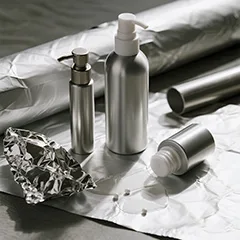
Producing aluminum from recycled scrap requires only 5% of the energy needed to produce primary aluminum from bauxite ore. By choosing our recycled aluminum cans, you are essentially banking energy.
Navigating the 2025 Regulatory Landscape
Packaging is no longer just about design; it’s about legal compliance. Governments worldwide are implementing strict Extended Producer Responsibility (EPR) laws.
🇪🇺 EU Packaging Directive (PPWR)
By 2030, all plastic packaging on the EU market must be recyclable. Golden Soar’s Mono-material PP pumps and Al-free tubes are fully compliant with these upcoming design-for-recycling mandates.
🇬🇧 UK Plastic Packaging Tax
Packaging containing less than 30% recycled plastic is taxed at £210+ per tonne. Our certified 30% PCR-PET bottles allow you to exempt your products from this tax completely.
🇺🇸 California SB 54
Requires single-use packaging to be recyclable or compostable by 2032. We provide the necessary material safety data sheets (MSDS) to prove compliance for the US market.
Eco-Materials Technical FAQ
Start Your Sustainable Journey
Verify the quality yourself. Request a curated sample kit containing our PCR, Bio-PE, and Aluminum solutions.
 English
 Español
 Русский
 日本語
日本語 한국어
한국어 Français
 العربية
 Português