
What Is PE Material — A Practical, Buyer-First Guide
Polyethylene (PE) is the world’s most widely used thermoplastic. On this page you’ll learn exactly what it is,
how it behaves in real packaging, and why buyers choose PE for beauty, personal care, household and travel kits.
We pair each topic with a compact, 3D-hover visual so you can see and
feel how PE works in the hand.
LDPE • HDPE • LLDPE • MDPE
Recyclable Code ♻︎ 2 & 4
Squeezable • Tough • Lightweight
Explore Goldensoar PE Range

Definition & Resin Families
Polyethylene (PE) is a family of polyolefin plastics created by polymerizing ethylene monomers.
Depending on density and branching, PE is classified as LDPE (low density), LLDPE (linear low),
MDPE (medium) and HDPE (high density). These grades share a waxy, chemically resistant backbone,
but they feel different in the hand: LDPE/LLDPE are supple and elastic—perfect for squeezable bottles—while
HDPE is stiffer and more shape-stable for upright containers that must survive shipping and warehouse stacking.
At typical wall thicknesses used in beauty and home-care packaging, PE delivers impact strength,
stress-crack resistance and low mass. It can be colored, textured, frosted or
left naturally translucent for fill-level visibility. Most importantly for operations, PE forms reliable threads
for pumps, flip-tops and disc caps, and runs efficiently on blow-molding and extrusion lines with low energy load.

PE in the Real World: Squeezability with Precision
Buyers choose PE when controlled dispensing matters. In hand soaps, gels and travel lotions,
the bottle should flex without whitening or creasing, snap back after squeeze, and seal securely after cap closure.
Goldensoar’s 4 oz PE squeeze bottle
demonstrates the formula: a resilient shoulder, living-hinge flip top, and a neck finish that accepts standard closures.
The result is a bottle that ships light, survives drops, and presents cleanly on shelf.
- Comfort squeeze at room or cold temperature—PE retains ductility across climates.
- Resistant to surfactants and most aqueous formulations used in personal care.
- Can be produced in color-masterbatch for brand consistency or in natural translucent for fill control.

Functional Design: PE Dual-Chamber, One Shell
Some formulas work best when separated until use—think two-step hair care, mix-to-activate cleanser,
or morning/night routines. A PE shell can be molded to host dual chambers with U-shaped geometry,
allowing two pumps or two flip caps on the same footprint. This saves shelf space and delights consumers with
a tidy, symmetric silhouette.
See our
PE Dual Chamber Bottle. The low-memory recovery of PE ensures consistent rebound after multiple actuations,
while the neck land supports leak-proof sealing during transport.

Playful, Safe & Kid-Friendly
PE’s toughness and forgiving edges make it ideal for kid-oriented packaging where safety and fun coexist.
Round corners and thicker walls are easy to achieve. Couple this with a foamer pump and you get dense, marshmallow-like
foam that kids actually enjoy using—reducing waste and improving hygiene habits.
Explore the
Cute PE Foam Pump Bottle for a friendly, creative form factor.
For brand differentiation, PE accepts embossed faces, animal shapes, or smart add-ons like brush/phone holders.
Our Duck-style PE bottle
shows how fun forms can still pass drop, leak and cap-torque requirements.

Key PE Properties — Explained for Buyers
- Chemical resistance: PE resists most detergents, surfactants, dilute acids/alkalis and alcohol blends used in hand soaps and hair care. This keeps bottles cosmetically clean and structurally sound over shelf life.
- Impact & drop: The long, flexible molecular chains absorb energy at cold and room temperatures, reducing crack propagation and saving loss during last-mile delivery.
- Process efficiency: Extrusion blow molding of PE is highly productive with short cycle times and friendly parison behavior, allowing quick color changes and consistent neck finishes.
- Decoration: Silk-screen, heat-transfer, in-mold labeling and soft-touch varnishes adhere well. Matte frost or glossy candy tones both read beautifully on shelf.
- Recyclability: HDPE (♻︎ 2) and LDPE (♻︎ 4) have established streams in many regions. Monomaterial bottle-and-closure solutions improve the chance of real recycling.
- Weight & logistics: Low density means more units per carton, fewer pallets, and lower freight emissions—high leverage for large retail programs.
Big-Format Durability: Laundry & Household
In heavy-duty formats like 1L laundry jugs, PE shines with handles that resist creep in warm warehouses and
threads that stay round after capping. Our
Whale-shape 1000ml PE bottle
proves that cute and industrially sound can coexist. The fun silhouette adds brand charisma while the
resin’s stiffness protects against panel suck-in after hot-fill cooling.

Refill, Reuse, Reduce — PE for Circularity
Refill programs work when the primary pack is pleasant to keep and easy to clean.
PE’s chemical resilience and weight advantage make it perfect for multi-cycle refills.
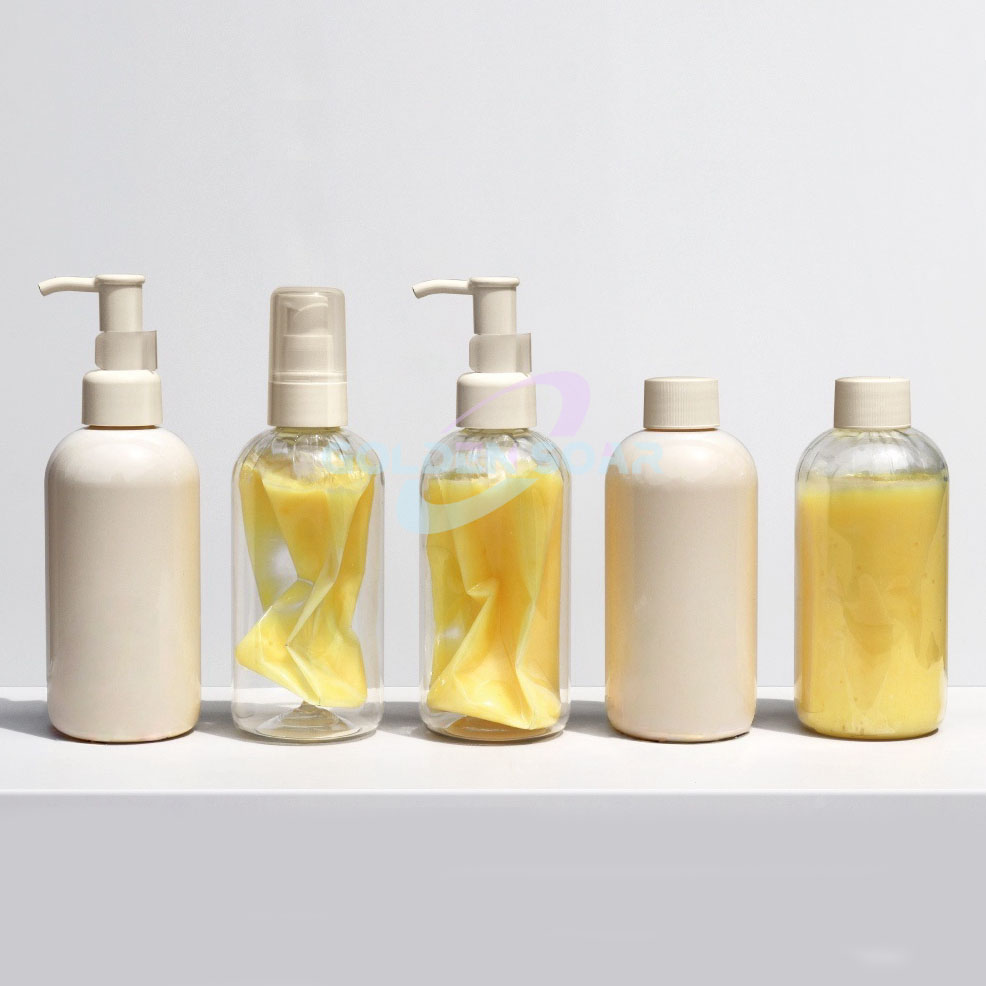
Pair with an airless pump for sensitive formulas: fewer preservatives, better evacuation rate.
See our refill system with airless PE.
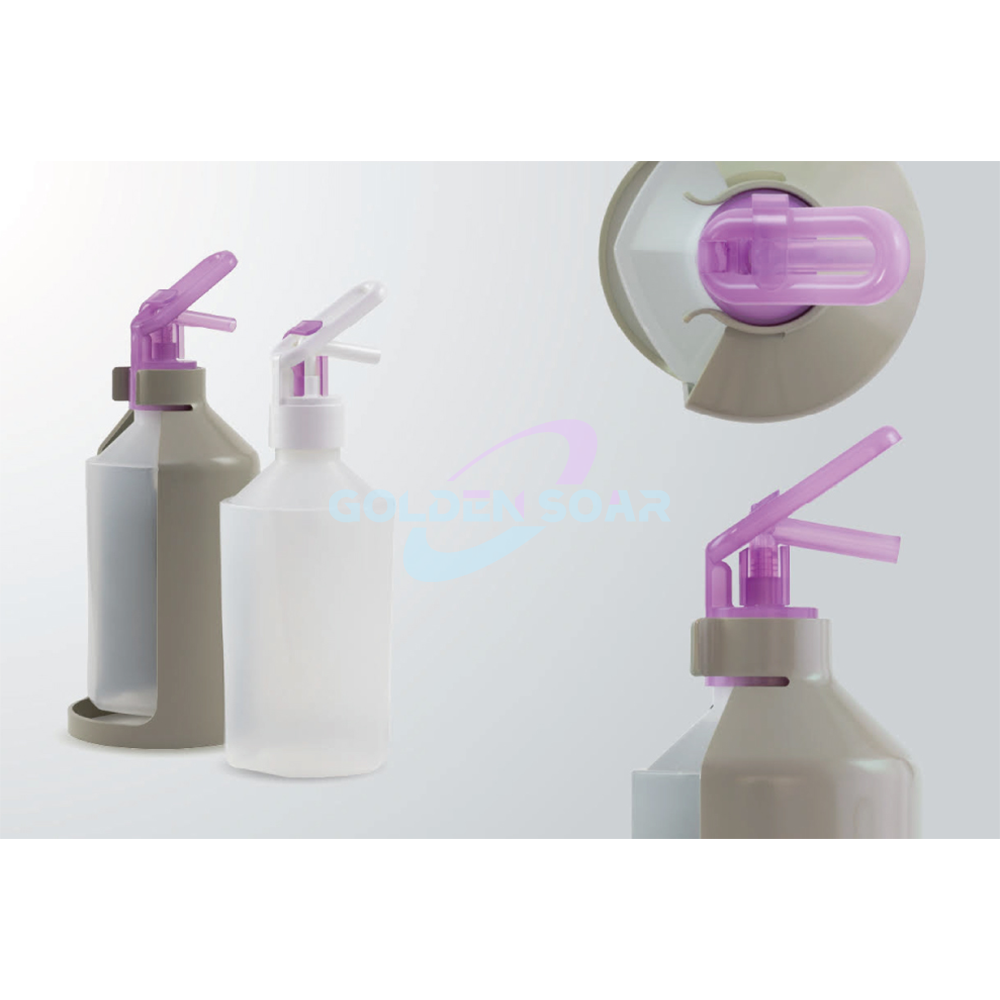
If your brand needs more transparency or higher gloss, a PET or PP variant can be used for fit-for-purpose parts (e.g., clear outer, PE inner pouch). We also offer
replaceable PET airless and
PP airless where those resins are preferred.
PE vs. PET, PP & Aluminum—Quick Fit Guide
- PE vs. PET: PET is glass-clear and high-gloss—great for showcasing color but less squeezable.
PE wins when tactile squeeze and drop strength matter more than optical clarity. - PE vs. PP: PP tolerates higher heat (e.g., steam sterilization) and hinges extremely well,
but PE is more forgiving at cold temperature and often nicer to squeeze. - PE vs. Aluminum: Aluminum excels in barrier and premium feel for sprays and aerosols.
We supply both—see our aluminum range—but for hand soap and lotions,
PE typically delivers the best cost-to-user-experience ratio.
Goldensoar manufactures across all these families—PET,
PP,
Aluminum—so we recommend without bias.

Advantages of PE Material for Buyers
- Lower total landed cost: Lightweight units reduce freight and e-commerce damage rates; high cavity tooling boosts throughput for scaling programs.
- Consumer-friendly ergonomics: Squeezable walls with smooth memory improve last-drop evacuation and reduce frustration—translating into better reviews.
- Versatile aesthetics: From silky matte to playful 3D forms, PE supports branding without complicated secondary operations.
- Reliable sealing: Thread profiles in PE maintain ovality after capping and during temperature changes, improving leak-proof performance in transport.
- Compliance-ready design: Monomaterial bottle + closure options help meet retailer recyclability goals and brand pledges.
- Supply assurance: PE resin has broad global availability, lowering risk for multi-region rollouts.
Everyday PE Workhorses
From small amenity kits to daily family bottles, there’s a PE format for every flow rate and viscosity.
Consider a 120ml PE lotion pump for face and body creams,
or choose the 150ml travel squeeze for shower gel where dosing accuracy
matters inside hotel bathrooms and gym bags.
When You Need a PE + Foam Experience
Foaming pumps are popular because they stretch each milliliter and feel luxurious.
While PET is often chosen for clarity, PE offers a softer, safer hand feel—especially useful in children’s and
family SKUs. The foam chamber sits in the pump; the bottle’s job is to be resilient, stable, and to carry a clean label.

Where PE Packaging Is Used
Goldensoar supplies PE across these application families:
Personal Care & Toiletries,
Cosmetic Packaging,
Travel Kit Packaging,
Pharmaceutical & Healthcare,
Food & Beverage,
and Household & Daily Use.
Compliance, Testing & Documentation
Buyers frequently request documentation such as material safety data, food/contact
compliance statements where applicable, and recyclability declarations for specific regions.
Goldensoar supports these requirements with traceable resin data and third-party test reports when projects demand them.
We align packaging specifications with your retailer and market requirements to reduce onboarding friction.
For eco-programs, we can propose monomaterial designs, post-consumer resin (PCR) options, and labeling that
improves sorting outcomes without compromising squeezability.
Bottom Line — Why Choose PE
PE gives you a rare combination of user comfort, operational efficiency and
brand design freedom. It is the pragmatic choice for soaps, shampoos, gels and lotions where
tactile quality and logistics cost matter as much as shelf appeal. You can scale quickly, decorate flexibly and
keep total cost of ownership low—all without sacrificing safety or durability.
Goldensoar — What Makes Us Different
- End-to-end manufacturing: We produce PE, PET, PP and Aluminum packs under one roof, so you select the right resin for the job—not just the one we sell.
- Design-to-line support: Our team helps with neck finishes, pump/cap torque windows, filling guidance and leak-proof lid design (see details) to accelerate your line trials.
- Category expertise: From personal care to healthcare, we tailor wall thickness, resin blend and closure system for each formula family.
- Clear how-to resources: Practical references such as filling guidelines,
TSA-approved sizes,
and easy-refill openings reduce onboarding time for your operations team. - Eco options: Explore eco materials and monomaterial builds that improve recyclability and support brand targets.
- Responsive service: Samples, drawings and iteration are fast—and backed by customer reviews.
Ready to build your next PE program? Visit our PE materials hub or contact us via
Company Profile. We’ll recommend the most economical, user-friendly solution and prove it on the line.
 English
 Español
 Русский
 日本語
日本語 한국어
한국어 Français
 العربية
 Português